


Aluminum Balcony Railing: Coastal Finish and Fastener Selection
A coastal balcony can look pristine at handover and begin showing corrosion around its fixings before the rest of the façade appears weathered. The problem is rarely aluminum alone. Salt deposits, damaged coating edges, incompatible hardware, and water trapped inside connections often work together.
For project managers, selecting an aluminum balcony railing therefore means looking beyond color and profile. The finish system, fasteners, anchorage, drainage details, and maintenance access need to form one coordinated specification. Getting these decisions settled before procurement is usually less disruptive than replacing stained brackets or investigating loose connections on occupied balconies.
The practical aim is not to promise a maintenance-free railing. It is to deliver a system whose corrosion protection matches the exposure, whose connections remain structurally reliable, and whose upkeep is realistic for the building operator.
Start with exposure—not simply distance from the sea
“Suitable for coastal use” is too broad to guide purchasing. Two buildings on the same waterfront can expose their railings to very different conditions. One may receive wind-driven spray and regular rain washing; another may have sheltered balconies where salt accumulates beneath handrails and around post bases.
Before asking suppliers to recommend a finish, document the conditions that matter:
- Salt exposure: direct sea spray, airborne salt, prevailing winds, and nearby breaking surf.
- Wetting and drying: rainfall, humidity, shaded areas, and surfaces that remain damp.
- Connection geometry: enclosed sleeves, horizontal ledges, base plates, and narrow joints that can retain salty water.
- Other contamination: pool chemicals, cleaning agents, construction dust, or industrial pollutants.
- Maintenance access: whether crews can reach both sides of the railing and concealed connection areas.
This exposure review should accompany the railing schedule. It gives the coating supplier, fabricator, and structural designer a shared basis for decisions rather than leaving “marine grade” open to interpretation.
Choosing an aluminum balcony railing finish for coastal service
Aluminum develops a protective oxide layer, but chloride-rich moisture can still cause localized attack, particularly at crevices and dissimilar-metal connections. A suitable finish improves resistance and appearance retention; it does not eliminate the need for sound detailing.
Powder coating: specify the system behind the color
Powder coating offers a broad choice of colors and textures, making it attractive for residential developments and coordinated door, window, and balcony packages. However, the word “powder-coated” says little about long-term coastal performance.
Request the coating chemistry, applicable architectural performance standard, substrate preparation process, and applicator quality controls. Where AAMA specifications are relevant, AAMA 2603, 2604, and 2605 represent different performance requirements for organic coatings on architectural aluminum. They should not be treated as interchangeable, and compliance must relate to the proposed coating system—not merely a supplier’s general capability.
For demanding exposure, consider a documented high-performance system, including a qualified powder option where available. Pretreatment is especially important: a premium topcoat cannot compensate for contamination or inadequate preparation. Ask how welds, recesses, drainage openings, and sharp edges are prepared and coated, since these areas can be harder to protect consistently.
Liquid-applied fluoropolymer coatings: assess the complete specification
High-performance liquid-applied fluoropolymer systems are another option where color retention and weathering resistance are priorities. They may suit projects seeking a coordinated finish across railings and other architectural aluminum components.
Do not select on resin terminology alone. Verify the specified system, pretreatment, primer where required, application process, and relevant performance documentation. Also confirm that the fabricator can accommodate the coating process without delaying assembly or creating unprotected areas during later drilling.
Anodizing: an alternative with its own coordination needs
Anodizing creates an oxide layer integral to the aluminum surface rather than an applied paint film. Properly specified anodizing can perform well in coastal architectural applications, but alloy selection, anodic coating thickness, and sealing quality matter. Where appropriate, specify architectural anodizing to AAMA 611 or the applicable regional standard.
Appearance deserves early attention. Extrusions, welds, and cast components may respond differently to anodizing, producing visible variation. Obtain representative samples of the actual component types, not just a small color chip. Confirm how field cuts and scratches will be handled, because anodizing cannot be recreated on site with touch-up paint.
Fasteners: stainless steel is a starting point, not the whole answer
For many coastal railing connections, 316 stainless steel is a more appropriate starting point than 304 because it generally offers better resistance to chloride-related corrosion. Nevertheless, 316 is not immune to pitting or crevice corrosion, especially where salt solution remains trapped.
Specify a recognized material designation and the mechanical properties needed for the connection. A corrosion-resistant screw with insufficient strength, poor thread engagement, or unsuitable geometry is not an acceptable substitution. Anchor selection must also account for the substrate, loads, edge distances, embedment, and any cracked-concrete requirements applicable to the project.
Be cautious with generic zinc-plated carbon-steel hardware in exposed coastal locations. A low-cost fixing can become the weakest element in an otherwise well-protected railing. If coated steel fasteners are proposed, require evidence that their protection system is suitable for the actual exposure and compatible with the aluminum assembly.
Control galvanic contact without compromising the connection
Stainless steel and aluminum can form a galvanic couple when electrically connected in the presence of an electrolyte such as salty water. The aluminum is the more vulnerable material. Risk increases around damaged coating and persistent wet crevices, so stainless hardware should not be considered automatically harmless to aluminum.
Possible controls include insulating sleeves, suitable washers, gaskets, and compatible jointing compounds. These measures need engineering review. A soft washer or compressible pad placed in a structural load path may creep, alter clamping force, or affect connection stiffness. Isolation details must preserve the designed load transfer and tightening requirements.
Likewise, coatings alone are not a dependable isolation strategy at every fixing: installation can damage the film beneath bolt heads or along hole edges. Show the intended isolation arrangement on connection drawings rather than relying on installers to improvise.
Look closely at the post base and concealed joints
The most useful coastal design review often happens at detail scale. Trace how water enters a connection, where it can collect, and how it leaves. Then consider whether maintenance crews can inspect that same area after installation.
At a balcony post base, coordinate the base plate, anchor holes, waterproofing interface, isolation materials, and drainage provisions. A decorative cover may conceal hardware neatly while also hiding standing water. Covers should not create an uninspectable salt trap.
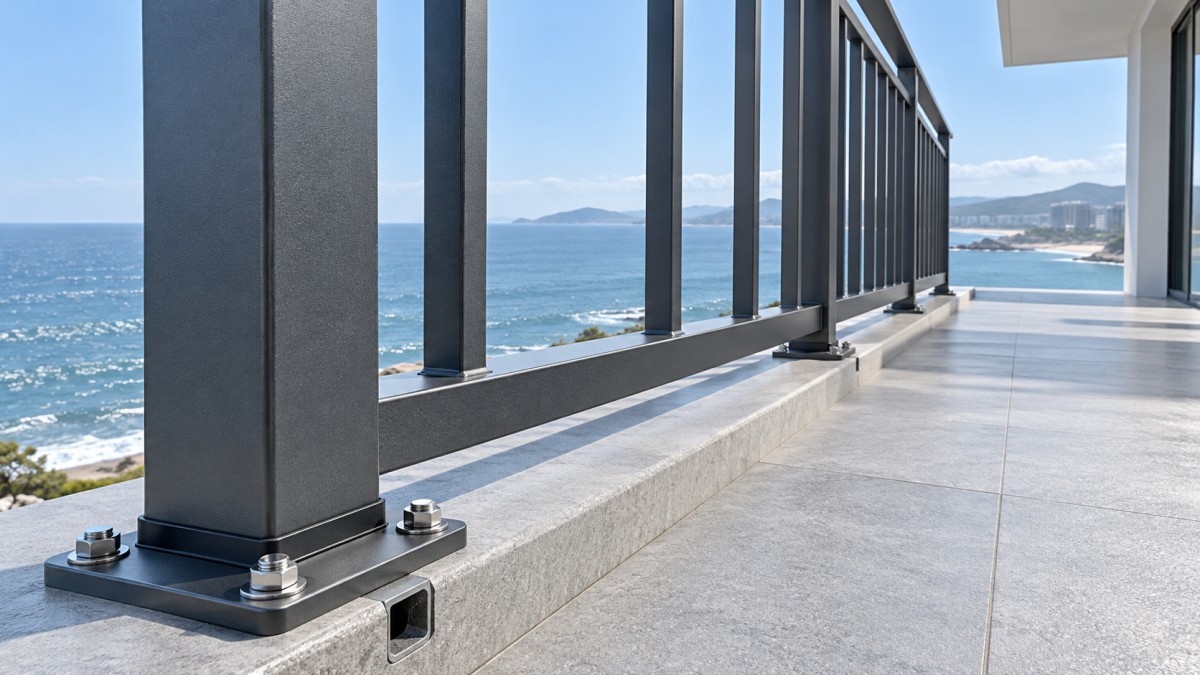
For hollow posts and rails, provide intentional drainage where the system design requires it. Drainage holes must remain open after coating and installation, and they must not discharge into a vulnerable waterproofing interface. Avoid sealing a cavity in a way that still permits water entry but prevents escape.
Sealants can help manage water at defined joints, but they are not a substitute for drainage or corrosion protection. Specify products compatible with the coating, aluminum, adjacent materials, and waterproofing system. Confirm cure requirements and joint movement capacity rather than choosing a sealant solely by color.
Keep aluminum separated from incompatible adjacent materials where necessary. Copper runoff, direct contact with dissimilar metals, and exposure to wet alkaline construction materials can create problems. Balcony screeds, façade interfaces, and temporary construction conditions deserve the same attention as the finished elevation.
Turn the selection into a procurement package
A useful railing specification makes substitutions easy to assess and difficult to disguise. Organize the submittal requirements around evidence rather than descriptive labels:
- Assembly drawings: profiles, connections, drainage, isolation, anchorage, and waterproofing interfaces.
- Structural documentation: applicable guard loads, attachment design, and required testing or calculations.
- Finish documentation: coating or anodizing designation, preparation requirements, application controls, and representative samples.
- Hardware schedule: material grade, strength requirements, anchor type, isolation accessories, and installation instructions.
- Care and warranty terms: cleaning requirements, exclusions, inspection access, and approved repair procedures.
Aluminum Art manufactures aluminum guardrails alongside doors, stair handrails, and related accessories, making component coordination a relevant discussion during procurement. Its GFR-49 Aluminum alloy guardrail is an aluminum option intended for modern buildings. For a coastal project, request the proposed finish, hardware schedule, connection details, and structural documentation before confirming suitability; the product description alone does not establish marine-exposure performance.
Also agree who supplies each small component. Insulating washers, sleeves, compatible sealants, and replacement fasteners can fall between the railing supplier and installation contractor. A complete bill of materials helps prevent site teams from replacing an overlooked accessory with whatever is available locally.
Protect the specification through installation
Even a carefully selected system can lose its advantages on site. Build a short inspection sequence into the installation plan, beginning with delivery condition and ending with connection checks.
Store components clear of standing water and contamination. Follow supplier guidance for protective wrapping, particularly where trapped moisture or adhesive residue may affect the finish. Keep carbon-steel grinding debris away from coated aluminum; embedded particles can rust and leave staining that is mistaken for failure of the aluminum itself.
Complete fabrication before final finishing where practical. If field drilling or cutting is unavoidable, use the manufacturer’s approved treatment and repair procedure. Touch-up material may improve local protection or appearance, but it should not be assumed equivalent to the original factory finish.
Inspect fastener identity, isolation components, hole condition, and tightening procedure before decorative covers conceal the connections. Follow the connection designer’s torque or installation requirements, and ensure any lubricant or anti-seize compound is approved for the materials and accounted for in tightening instructions.
A representative first installation is worth reviewing before the remaining balconies proceed. It can reveal awkward access, missing drainage clearance, or conflicts with waterproofing while corrections are still manageable.
Plan maintenance around the places salt stays
Rain does not reliably clean sheltered undersides, post bases, or enclosed joints. Include freshwater washing and manufacturer-approved mild cleaning in the handover plan, with frequency adjusted to actual exposure and observed salt accumulation. Avoid abrasive tools and unapproved acidic or alkaline cleaners.
Periodic inspections should look for coating damage, white corrosion deposits, rust staining from hardware or contamination, loose connections, failed sealant, and blocked drainage. Structural concerns require qualified assessment rather than cosmetic repair alone.
The best coastal aluminum balcony railing specification connects four decisions: exposure-appropriate finishing, compatible and structurally suitable fasteners, water-shedding details, and achievable maintenance. For
Related Posts
CONTACT US

First class quality service and professional after-sales team.
Get in Touch
*We respect your confidentiality and all information are protected.