


Aluminum Door Hardware Compatibility: Checks Before Placing Bulk Orders
Approve a bulk order for aluminum door hardware only after the complete assembly fits the intended door and operates correctly. A matching finish, a familiar model number, and an attractive unit price do not establish compatibility. Hinges, locks, handles, closers, and fasteners must work with the door profile, its supporting structure, and each other.
The expensive mistakes often appear during installation: a lock case clashes with an internal rib, hinge screws have too little material to grip, or a handle hits the frame before the door opens fully. Preventing these problems starts with dimensioned drawings and ends with an assembled sample. The quotation should follow the approved specification, so every supplier prices the same usable hardware set.
Define the door assembly before comparing hardware prices
“Suitable for aluminum doors” is too broad to be a purchasing specification. A narrow-stile entrance door, a decorative cast aluminum door, and an outdoor courtyard gate can require different mounting arrangements. The hardware material alone does not tell you whether it will fit or carry the intended load.
Start with a door schedule that identifies each configuration: single or double leaf, opening direction, frame profile, finished leaf dimensions, estimated finished weight, and installation environment. Include glass, decorative panels, and other components when calculating weight. Record the drawing revision alongside each hardware set to prevent an earlier door design from being paired with a later hardware specification.
For cast aluminum doors, establish what actually supports the hinges and lock. Decorative cast sections, internal framing, and local reinforcement may have different roles. A substantial-looking door face does not establish that every mounting location can hold a threaded fastener. Ask for section drawings showing the attachment points and reinforcement.
Also define how the opening will be used. A sheltered residential entrance presents different demands from a frequently used commercial entrance or an exposed courtyard gate. These differences affect operating cycles, corrosion protection, closing control, and maintenance access.
Check dimensions at the interfaces that can stop installation
A hardware drawing becomes useful when it can be compared directly with the door and frame drawings. Overall dimensions are only part of the check. The positions of fixing holes, internal cavities, moving parts, and adjacent seals determine whether the assembly works.
Lock backset is the distance from the reference edge specified on the lock drawing to the spindle or cylinder centerline. It matters because the handle and cylinder must sit in usable positions while the lock case fits inside the stile. On a narrow profile, internal ribs or reinforcement can block a case that appears suitable from the outside.
Door thickness also needs careful interpretation. The overall thickness may differ from the thickness at the handle fixing points. Spindles, through-bolts, and cylinders must suit the actual assembly, including escutcheons and cover plates. An overly long cylinder may project unnecessarily; a short one may not fit the trim properly.
Finished surfaces affect fit as well. Coatings can reduce tight clearances, and seals change the resistance the latch must overcome. Include fabrication and finishing tolerances in the drawing review instead of assuming every production door will match the sample exactly.
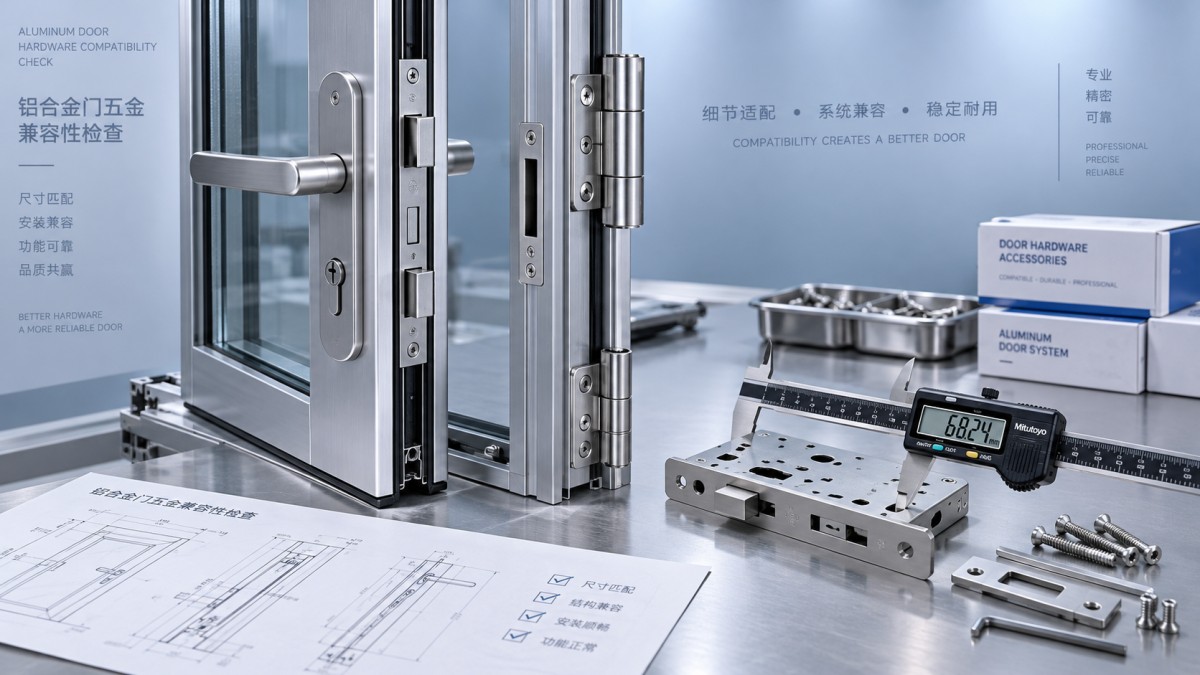
Match hinges to the door and its supporting structure
Leaf weight is an essential starting point, but it is not enough to select hinges. A wide leaf places greater leverage on its supports than a narrower leaf of similar weight. Hinge spacing, opening frequency, closer forces, and exposure to wind also affect the assembly.
Read hinge capacity information together with its installation conditions. A stated capacity may depend on the number of hinges, their spacing, the door dimensions, and the mounting method. Adding another hinge does not automatically increase capacity in a predictable way, especially if alignment or reinforcement is inadequate.
For doors made from hollow extruded profiles, determine whether the specified screws need threaded inserts, backing plates, or reinforced sections. A strong hinge attached to an unsuitable wall section can still loosen or damage the profile. For a heavy cast aluminum leaf, the load path from hinge to supporting frame deserves particular attention.
Adjustment is valuable when it accommodates normal fabrication and installation variation. It should not be used to compensate for incompatible geometry. Confirm that adjustment screws remain accessible after installation and that moving the leaf into alignment does not leave the latch or seals outside their working range.
Treat locks, handles, and closing devices as one operating system
A lock can fit perfectly and still operate poorly once the other components are installed. Seal pressure may prevent the latch from engaging. A closer may struggle to pull the leaf through the final closing movement. A handle may have insufficient return action for the selected lock arrangement.
Specify the required access function before choosing the hardware set. Decide whether the door needs keyed access, controlled entry, free exit, or a particular emergency-release arrangement. Where the opening has fire or escape requirements, select hardware and modifications that preserve the required performance of the complete door assembly.
For double doors, identify the active and inactive leaves, the meeting-stile arrangement, and any flush bolts, keeps, or closing sequence requirements. Misalignment between the leaves can prevent a multipoint lock from engaging even when each component matches its individual drawing.
Outdoor gates need a separate assessment. Wind can interfere with controlled closing, while post movement or ground settlement can change latch alignment. Gate posts, stops, hinges, and any automation brackets must be considered together. An indoor closer should not be carried into an exposed gate specification simply because its mounting holes can be made to fit.
Specify corrosion protection beyond the visible finish
The term aluminum door hardware describes the application; the components may contain stainless steel, plated steel, zinc alloy, brass, aluminum, or combinations of these materials. Their suitability depends on exposure, surface protection, drainage, and how different metals meet.
Where dissimilar metals contact aluminum in the presence of moisture, galvanic corrosion can damage the less resistant part of the connection. Appropriate isolating washers, sleeves, gaskets, or protective treatments can reduce that risk when they suit the mechanical design. An isolation detail must still allow the joint to carry its intended load.
Coastal exposure, frequent wetting, and cleaning chemicals deserve explicit attention in the specification. Include fasteners, internal springs, bearings, and hidden brackets in the material review. A corrosion-resistant handle cover does not protect an unsuitable steel screw behind it.
For projects combining gates, doors, and perimeter barriers, coordinate appearance while keeping each connection technically specified. Aluminum Art supplies entrance products and guardrails; its Aluminum alloy guardrail, model LX-1080, is an aluminum alloy option for residential and commercial applications. If included in the same package, its fixing details and finish sample should be reviewed separately from the door hardware.
Use an assembled sample to expose costs drawings can miss
A loose hinge or lock sample can establish appearance and some dimensions, but it cannot demonstrate compatibility with the complete opening. Build a representative assembly using the intended profile, reinforcement, seals, finish, and fasteners. Include the frame and threshold wherever they affect operation.
The sample should answer practical installation questions: Can the lock be fitted without unexpected cutting? Can tools reach the screws? Does the handle clear the frame? Can the door open through the intended angle? Does the latch engage without lifting or pushing the leaf into position?
Check operation with the closing device connected and the seals installed. Exercise the lock from both sides, inspect double-leaf sequencing where applicable, and check for contact or movement at fixing points. This fit-and-function check complements documented load, durability, and environmental performance; it does not establish those properties by itself.
Keep the approved sample as a reference, supported by photographs, drawings, and a component list. Record any changes made during assembly. If installation required a different bolt, an added spacer, or a revised strike, incorporate that change into the order specification before production begins.
Compare the installed cost of complete hardware sets
A low unit price can hide missing accessories or extra installation work. Compare quotations against the same bill of materials, including hinges, lock bodies, cylinders, handles, strikes, brackets, fixing packs, cover plates, and any required reinforcement or isolation components.
Ask suppliers to identify what is included, what is supplied separately, and what machining the door manufacturer must provide. Pre-machined preparation may cost more at purchase while reducing work during assembly. Conversely, a nominally inexpensive component may require special tooling or manual adjustment on every door.
Separate costs that apply once from costs that recur across the order. Samples, tooling, and setup differ from per-door assembly labor, missing fixings, and packaging. Replacement availability also matters: an unusual fixing pattern can make a future repair more expensive if an equivalent component cannot use the existing preparation.
Standardizing hardware across several openings can simplify stock and maintenance when the door dimensions, loads, and functions are compatible. Where they differ, use separate approved sets. Forcing one model onto every opening can transfer purchasing savings into fabrication work and service problems.
Make the approved specification part of the purchase order
Before releasing the order, turn the sample approval into a clear production requirement. A catalog description or finish name leaves too much room for variation. The order documents should identify:
- Component models, quantities, handing, and the door configuration each set serves.
- Approved drawings, preparation dimensions, tolerances, and revision references.
- Materials, finishes, fasteners, reinforcement, and included accessories.
- The approved sample reference and the checks used to accept production goods.
- Packaging by hardware set, component labels, and agreed spare parts.
- A requirement for written approval before component or material substitutions.
Organize incoming inspection around the features that determine fit: fixing centers, lock dimensions, handing, spindle and bolt lengths, finish condition, and accessory completeness. Labels should let each pack be matched to the correct opening without guesswork.
Release the bulk order when the drawings, assembled sample, and quotation describe the same deliverable. If a hinge attachment, lock clearance, or closing action remains unresolved, resolve that interface before multiplying it across the production quantity. That is where a modest amount of preparation can prevent a much larger installation cost.
Related Posts
CONTACT US

First class quality service and professional after-sales team.
Get in Touch
*We respect your confidentiality and all information are protected.