


Aluminum Gate vs. Steel Gate: Upfront Cost and Long-Term Maintenance
A steel gate may have the lower purchase price, but an aluminum gate can cost less to maintain, especially where humidity, salt exposure, or frequent wetting make corrosion control a recurring expense. Neither material is automatically the cheaper choice: gate dimensions, structural design, finish quality, hardware, and installation conditions can outweigh the difference in material price.
When two supplier quotes arrive with different totals, the immediate problem is deciding whether they cover equivalent gate systems. A low-priced steel proposal without a defined corrosion-protection system is not directly comparable to a finished aluminum assembly with specified hinges and posts. Awarding the order on headline price alone can leave the project paying separately for installation changes, coating repairs, or premature hardware replacement.
Start with equivalent specifications, not equivalent appearances
Two gates can look nearly identical while differing substantially in frame thickness, reinforcement, weld quality, coating preparation, and supporting hardware. Before comparing costs, establish the opening width, gate height, swing or sliding operation, infill style, exposure conditions, and expected frequency of use. Both suppliers should quote against the same requirements.
Also clarify what “steel” means in the proposal. Painted carbon steel, galvanized steel, and galvanized steel with a compatible topcoat have different purchase and maintenance implications. For aluminum, identify whether the construction uses extruded sections, cast components, or a combination. Decorative cast elements do not establish the structural capacity of the complete gate.
Appearance should be compared through drawings and finish samples, while performance should be checked through specifications. A heavier gate is not necessarily better engineered, and a lighter gate is not necessarily suitable for the same opening.
Where the upfront price difference comes from
Raw material is only one part of the delivered cost. Elaborate decoration, custom profiles, extensive welding, complex finishes, and small production quantities can increase either quote. A simple steel gate may cost less than a highly decorative aluminum design, but that comparison says little about the relative cost of equivalent systems.
Ask suppliers to separate the gate assembly from posts, hinges or rollers, locks, automation, freight, and installation. Without this breakdown, one supplier may appear cheaper simply because essential items are excluded. Packaging also matters: large finished assemblies need protection against distortion and surface damage during transport.
Weight affects more than freight
Aluminum is less dense than steel, so comparable gate designs often weigh less. However, aluminum sections may need different dimensions or reinforcement to achieve the required stiffness. Use the supplier’s actual assembly weight rather than estimating installation savings from material type alone.
A heavy swing gate can require different hinges, stronger posts, and more demanding handling equipment. For sliding gates, roller capacity, track or cantilever design, and foundation requirements also affect installed cost. These are design decisions, not costs that can safely be removed to meet a purchasing target.
Automation needs separate attention. Operator selection depends on gate geometry, operating frequency, friction, wind exposure, and weight. A lightweight, solid-panel gate can still impose substantial wind loads. Do not assume that choosing aluminum automatically allows a smaller motor or simpler foundation.
Corrosion exposure changes the maintenance budget
On a sheltered inland property, a properly protected steel gate may remain a practical, economical option. At an exposed entrance near saltwater, or where irrigation repeatedly wets the lower frame, maintaining steel protection can require more attention. The purchasing decision should reflect the actual exposure rather than a generic “outdoor use” description.
Aluminum forms a protective oxide layer and does not rust like carbon steel. That does not make it immune to deterioration. Salt deposits, aggressive cleaners, standing moisture, unsuitable coatings, and contact with dissimilar metals can contribute to corrosion or finish damage. Drainage and compatible fasteners matter alongside the base material.
Steel depends more heavily on its protective system remaining effective. Scratches, weld areas, cut edges, and moisture traps deserve particular scrutiny. Galvanizing can provide sacrificial protection, while paint or powder coating adds a barrier; the performance of either depends on preparation, coverage, and service conditions.
Inspect the details most likely to hold water or suffer abrasion: lower rails, hollow sections, hinge brackets, latch contact points, and connections to posts. For coated galvanized steel, ask how the supplier prepares the galvanized surface and addresses fabrication or installation damage. For aluminum, ask how dissimilar-metal connections are isolated where necessary.
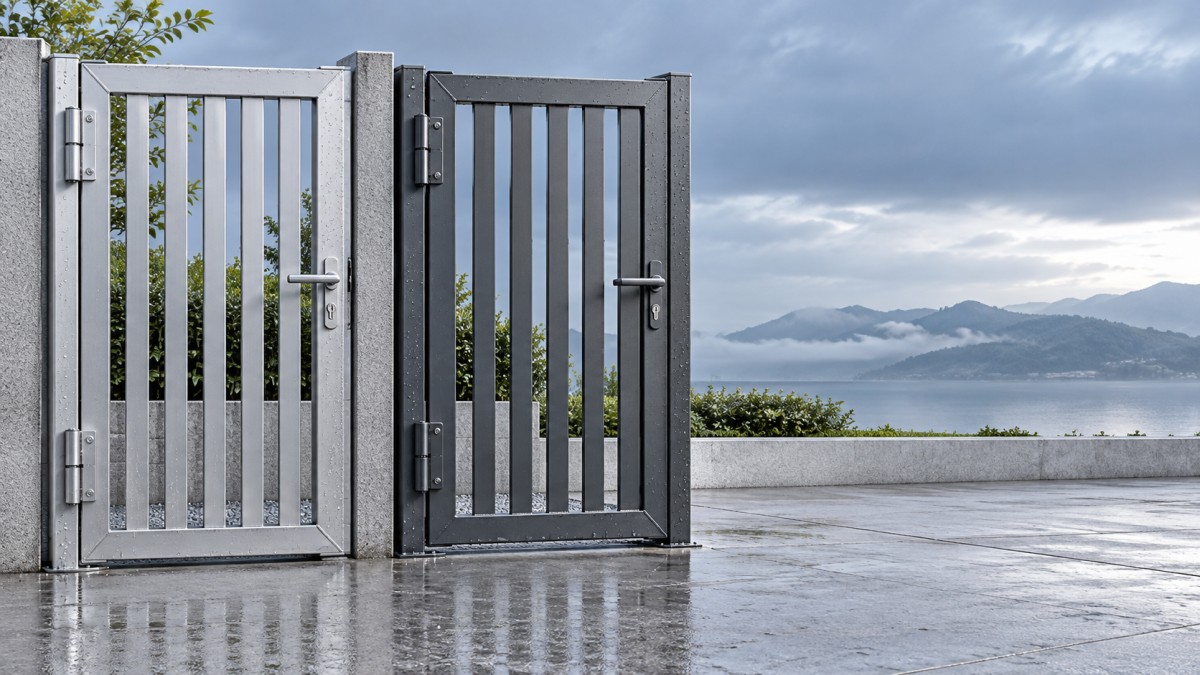
A finish sample shows color and texture, but it cannot confirm preparation quality or protection inside inaccessible areas. Request the specified pretreatment, coating system, and repair procedure. A proposal that states only “powder coated” leaves important maintenance assumptions unresolved.
Compare maintenance tasks, not “maintenance-free” claims
Both materials need periodic cleaning, hardware inspection, and servicing appropriate to the gate system. Hinges, rollers, latches, operators, and safety devices may need attention regardless of the frame material. Separate these shared tasks from material-specific work so the lifecycle comparison does not incorrectly credit aluminum with eliminating all maintenance.
- For aluminum: budget for cleaning, finish inspection, compatible touch-up work where specified, and checks around joints and fasteners for localized corrosion.
- For steel: include the same routine servicing, plus inspection for rust, preparation of affected surfaces, and restoration of the protective system when required.
- For either system: include access arrangements, labor, consumables, and any disruption caused by taking the entrance out of service.
Cleaning and inspection intervals should follow supplier guidance and site exposure. A coastal entrance may need more frequent salt removal than a sheltered residential installation. Avoid applying one assumed repainting schedule to every steel gate or one fixed service life to every aluminum gate.
Repairability also affects cost. Ask whether damaged infill, decorative components, hinges, and finish materials are available separately. Replacing a removable component can be less disruptive than repairing a fully welded assembly, but that benefit depends on the design and continued parts availability, not simply the metal selected.
Build a lifecycle comparison that can survive review
A useful cost model starts with installed cost and adds the expenses expected over the organization’s chosen ownership period. Use supplier information, site conditions, and local service quotations to establish assumptions. Do not substitute unsupported claims about how long either material will last.
Lifecycle cost = purchase and delivery + installation + planned maintenance + expected repairs and component replacement + downtime costs − any supported residual value.
Keep uncertain items visible. Coating repair frequency, labor rates, replacement-part availability, and exposure-related deterioration may not be known precisely at tender stage. Instead of presenting one total as certain, compare reasonable scenarios and identify which assumptions could change the preferred option.
- Normalize both bids to the same opening, operation, finish expectations, and installation scope.
- Separate shared maintenance, such as operator servicing, from material-specific coating work.
- Obtain local costs for cleaning, surface preparation, coating repairs, and access equipment.
- Include likely component replacement without assuming that every repair requires a new gate.
- Review the result under sheltered and more demanding exposure assumptions where site conditions are uncertain.
The break-even question is straightforward: can the aluminum option’s additional installed cost, if any, be offset by credible maintenance and repair savings during the ownership period? If the answer depends on assuming unusually frequent steel repainting, revisit the proposed steel protection system. Conversely, excluding coating work entirely can understate steel’s future costs.
Where the purchasing process uses discounted cash flow, apply the same approved discount rate and treatment of future costs to both options. Keep material selection separate from financing assumptions so the comparison remains auditable.
Match the choice to the entrance and adjoining fence
Aluminum often deserves priority where corrosion exposure is high, handling weight is constrained, or repeated coating repairs would disrupt operations. The specification must still demonstrate adequate stiffness, suitable connections, and compatible hardware. Its maintenance advantage cannot compensate for a gate that sags or performs poorly under site loads.
Steel can be a sound choice where the required structural design favors it, the initial budget is tight, and maintenance access is straightforward. Specify corrosion protection at the purchasing stage rather than leaving the installer to choose an unspecified paint system. Heavy-duty use or security requirements should be assessed against the complete assembly, not inferred from the word “steel.”
For projects that include perimeter fencing, the Aluminum alloy fence, model LX-1098, is an aluminum option listed for residential and commercial applications. It can be reviewed as part of the adjoining fence package, but its information does not establish gate load capacity, automation compatibility, or installation requirements. Obtain separate gate specifications and confirm how the fence, posts, and entrance connect.
Coordinating these packages can prevent unpriced interface work. Check finish compatibility, post locations, mounting details, and responsibility for site measurement. Matching colors alone does not ensure that the fence and gate share suitable support arrangements.
Resolve these items before placing the order
The final proposal should state the material and construction details, complete assembly weight, finish specification, included hardware, installation responsibilities, and maintenance instructions. Confirm warranty coverage and exclusions, particularly for coating damage, aggressive environments, and neglected maintenance. A warranty is not a substitute for a defined protection system.
For wide, tall, solid-panel, or automated gates, require confirmation of structural suitability and applicable safety requirements before award. Wind loading, supporting foundations, and automated-gate safeguards can change the design and budget materially; these are appropriate areas for qualified technical review.
Choose the lower installed-and-maintained cost only after both proposals satisfy the same performance requirements. Where aluminum carries a premium, record the exposure and maintenance assumptions that justify it. Where steel wins on cost, preserve the specified corrosion protection and repair allowance in the purchase documents so the saving is not achieved by leaving essential work unfunded.
Related Posts
CONTACT US

First class quality service and professional after-sales team.
Get in Touch
*We respect your confidentiality and all information are protected.