


Sizing an Operator for an Aluminum Gate: Weight, Width and Wind Loads
Sizing an Operator for an Aluminum Gate: Weight, Width and Wind Loads
Selecting an aluminum gate operator requires more than matching a motor to the gate’s weight. Gate width affects leverage, while panel design, local wind conditions and operating frequency influence the force required for reliable movement. A credible selection checks these factors against the manufacturer’s ratings and the actual site, rather than treating the largest number in a brochure as a guarantee.
Start with the gate’s movement, not the motor
A swing gate and a sliding gate can have the same weight yet impose very different demands. A swing operator must move a leaf around hinges; its geometry, mounting positions and opening angle all affect the force available through the travel. A sliding operator must overcome starting resistance and rolling friction, as well as any slope or track irregularity.
Before comparing models, record the weight and width of each swing leaf, or the total moving weight and travel distance of a sliding gate. Include locks, decorative castings, mesh and other attached components in the moving weight. For a double swing gate, check the rating and geometry for each leaf rather than simply dividing the total weight and assuming both sides are identical.
If the gate already exists, disconnect the operator only as permitted by its instructions and have a qualified installer check its manual movement. A binding hinge or damaged roller is a maintenance problem, not a reason to select a more powerful drive. Measure the starting and running force where practical; a pull gauge can reveal resistance that weight alone will not show.
Read weight and width ratings together
Manufacturer ratings may specify both maximum leaf weight and maximum leaf width. Those limits are not necessarily available at the same time: a capacity chart may reduce allowable weight as leaf width increases. Check the chart for the intended operating conditions instead of choosing an operator solely because the gate is below its headline weight rating.
For swing gates, the actuator’s mounting dimensions matter just as much. A deep masonry post, for example, can restrict bracket placement and change the operating geometry. Confirm the required opening angle, hinge offset and available mounting positions against the operator’s installation drawings before approving the model. An otherwise adequate motor may be unsuitable if it cannot be mounted within the prescribed geometry.
For a sliding gate, look for the manufacturer’s permitted gate weight, required drive force and track or cantilever requirements. A gate that rolls freely on a clean, level track may behave differently after debris collects or the track settles. Where a slope is present, assess its effect in both directions and obtain the operator manufacturer’s approval; do not assume a standard rating covers it.
Wind can be the deciding load
Aluminum reduces structural weight, but it does not eliminate wind pressure. A wide gate with solid infill can present a substantial area to the wind, while an open railing generally presents less. Mesh, decorative panels and the surrounding walls all complicate the picture, so the visible percentage of open space should not be treated as a precise wind-load calculation.
Wind force depends on pressure, effective exposed area and aerodynamic factors; on a swing leaf, the distribution of that force also affects the torque around the hinges. The load changes as the gate rotates. A sheltered driveway and an exposed entrance can therefore need different operator selections even when their gates have identical dimensions.
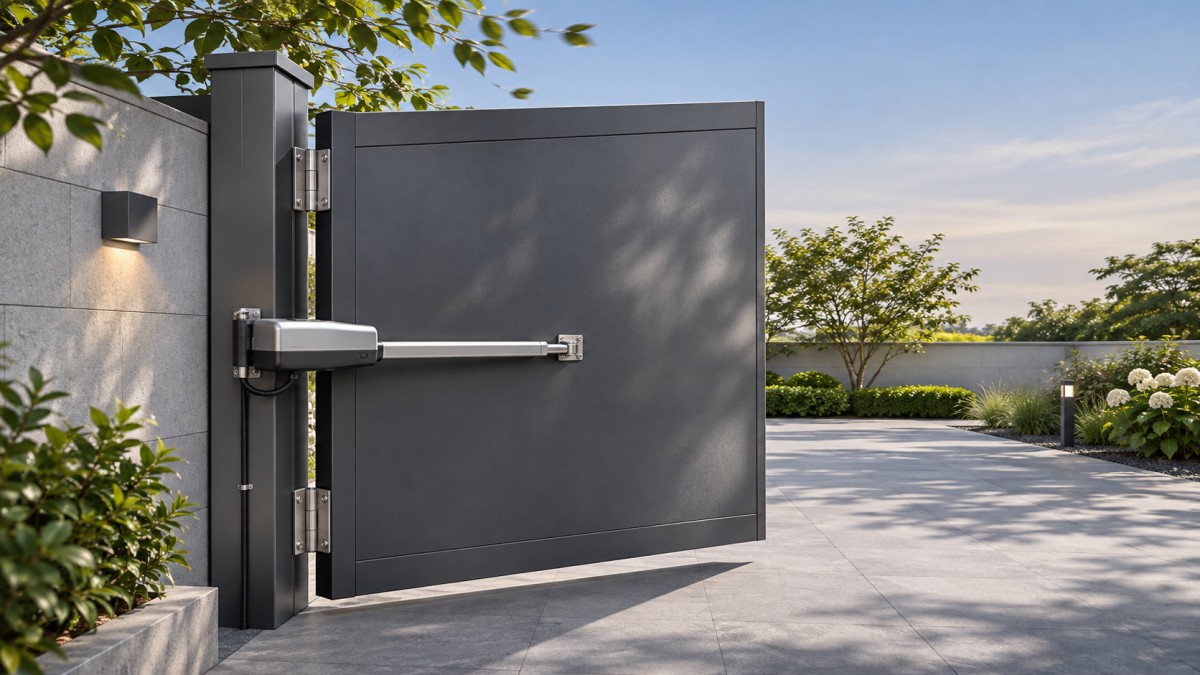
Ask the gate designer or a qualified engineer to assess wind loads using the applicable local requirements and site exposure. Then ask the operator supplier whether the proposed drive can move and hold the gate under the project’s specified conditions. Clarify whether operation is expected during strong winds or whether the gate must remain closed. A larger operator is not a substitute for adequately designed hinges, posts, foundations and stops.
Check the whole operating cycle
A residential entrance with occasional use places different thermal demands on a drive from a hotel or shared-access entrance with repeated cycles. Compare the expected number and pattern of operations with the manufacturer’s duty rating, including any limits on continuous use. Peak traffic matters: a daily total alone can hide a short period of frequent openings.
Also review power availability, backup requirements, control compatibility and the procedure for manual release. Opening speed should be considered alongside safety and duty requirements, not selected in isolation. Confirm how the gate is held closed and whether an electric lock is required by the operator manufacturer or the gate design.
Protective devices deserve attention at the selection stage. Pinch points, closing edges and the area swept by a gate need a site-specific risk assessment. Specify appropriate safeguards and commissioning tests under applicable local rules and the operator manufacturer’s instructions; adjustable force settings alone should not be assumed to provide complete protection.
Keep gate and door specifications separate
Aluminum Art manufactures courtyard gates and related metalwork as well as other aluminum door products. Its DM-1020 Aluminum Electric Sliding Door, for example, is listed for hotel applications with aluminum-alloy panels and optional fixed or sliding screens. Those details may help when coordinating an entrance package, but they do not establish the outdoor gate’s weight, wind resistance or operator capacity. Request the actual gate drawings and drive data separately.
Before signing off, provide the operator supplier with the gate dimensions, moving weight, infill design, mounting constraints, expected duty and wind assumptions. Ask for confirmation against its capacity chart and installation geometry. If any of those inputs remain unknown, treat the operator choice as provisional rather than compensating with an arbitrary oversize allowance.
Related Posts
CONTACT US

First class quality service and professional after-sales team.
Get in Touch
*We respect your confidentiality and all information are protected.