


Why an Aluminum Swing Door Sags: Hinge, Frame, and Closer Checks
An aluminum swing door that scrapes the threshold or misses the latch may have worn hinges, loose mounting screws, a distorted frame, or a door leaf that has lost its square shape. A closer can make the symptoms worse, but changing its speed or spring setting will not restore the position of a dropped door.
Start by finding which component moves and where contact occurs. Check the clearances, test the hinges under controlled support, inspect the frame, and then assess the closer. That sequence helps distinguish structural movement from a closing problem and avoids adjusting one component to compensate for a fault elsewhere.
Read the contact marks before making adjustments
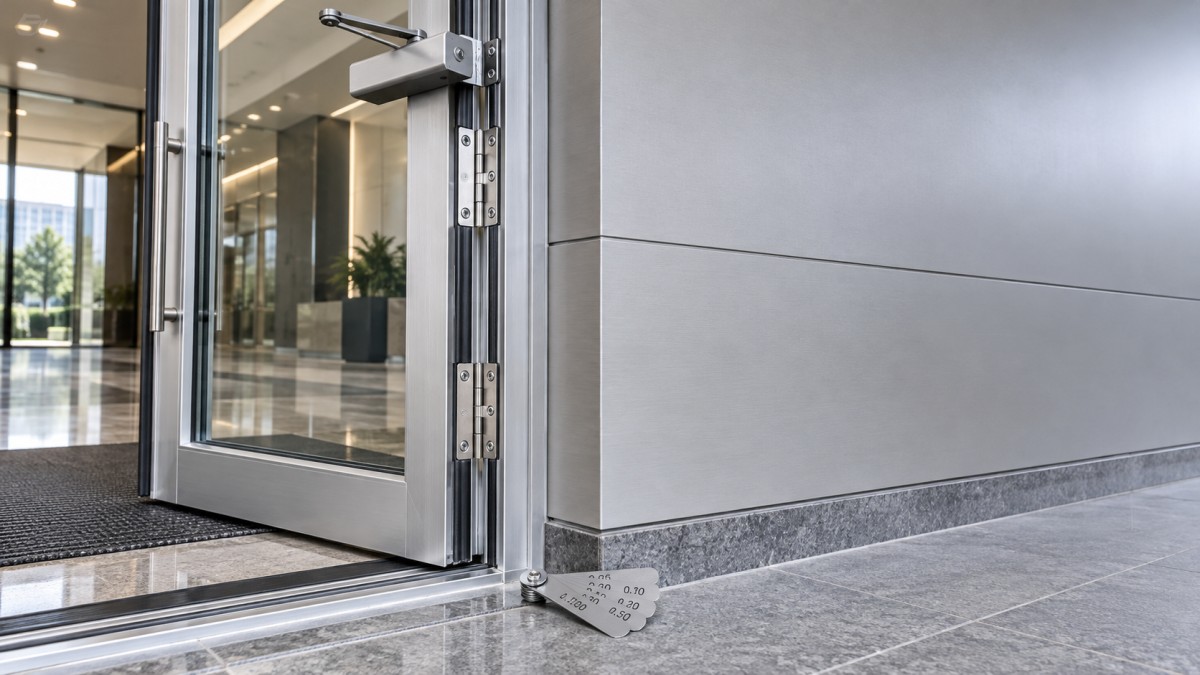
Operate the door slowly and note where resistance begins. Does the bottom corner catch throughout the swing, or only as the door enters the frame? Does the latch strike below its opening, or does it align correctly but fail to engage? These observations determine which checks deserve attention first.
A dropped latch-side corner often accompanies a head gap that widens toward the latch side. However, that pattern alone does not identify the cause: hinge movement, loose fixings, and distortion within the leaf can produce similar symptoms. Rubbing only near the closed position may indicate a twisted frame, displaced seal, or poorly positioned strike.
Before touching the hardware, record:
- The head, hinge-side, latch-side, and threshold clearances with the door almost closed.
- The location of scrape marks and whether they are fresh or longstanding.
- Whether the latch aligns when the door is moved gently by hand.
- Any recent impact, hardware replacement, glazing work, or change in floor finishes.
- Whether the problem varies with weather, building ventilation, or time of day.
Use the door system’s specified clearances as the reference. There is no single gap suitable for every aluminum entrance, particularly where seals, thermal breaks, or specialized hinges are involved. Photographs taken before adjustment also provide a useful baseline if the fault returns.
Check hinge play and mounting points separately
Secure the work area and support the leaf with suitable equipment before loosening load-bearing hardware. Heavy glazed doors can move suddenly when a hinge fixing is released. Keep fingers away from hinge gaps and avoid using the glass, handle, or threshold as a lifting point.
With the door partly open and controlled against swinging, gently unload the latch-side corner while watching each hinge and its mounting surface. Lift only enough to reveal movement; forcing the leaf upward can damage hardware or conceal where the play originates.
The useful distinction is between movement inside the hinge and movement between the hinge and the aluminum profile.
- The hinge leaf moves against the profile: suspect loose screws, damaged threads, a loose backing plate, or deformation around the fixing holes.
- The mounting remains still but the hinge joint moves: suspect wear in the pin, bush, bearing, or hinge assembly.
- The profile itself flexes or cracks: investigate the load-bearing section and reinforcement before adjusting the hinge.
- No clear hinge movement appears: continue to the frame and door-leaf checks rather than assuming the hinges are sound under every condition.
The upper hinge often deserves close attention because door weight creates a turning force that pulls on the upper support. Still, inspect every hinge. Misaligned hinge axes can cause binding, and a poorly positioned intermediate hinge can prevent otherwise serviceable hardware from moving freely.
If a screw turns without tightening, further tightening will not restore its grip. An oversized screw is also an unreliable repair unless the mounting arrangement specifically permits it. The connection may require restoration of the backing plate, an approved thread repair, or replacement of a damaged component.
Use the specified fasteners and tightening procedure. Excessive torque can strip threads or distort a thin aluminum wall. Where adjustable hinges are fitted, identify which controls change height, lateral position, and seal compression before turning them. Moving the wrong adjustment can correct one gap while creating a new bind.
Replace worn components with hardware compatible with the door’s weight, dimensions, mounting pattern, and exposure. Matching the visible hinge size is insufficient. Adding another hinge also requires a suitable profile and correct alignment; it does not automatically repair weak existing mounting points.
A firm hinge does not rule out frame or leaf movement
Check the hinge jamb and latch jamb for plumb, the head for level, and the opening for square. Compare frame diagonals where access allows, but combine those measurements with checks for local bowing and twist. Similar diagonals do not prove that both jambs lie in the same plane.
Look at the frame-to-wall connections while the door is operated gently. Movement at an anchor, a gap opening beside the frame, cracked finishes, or displaced packers can indicate that the frame is moving under load. Tightening accessible anchors without checking their support can pull the jamb into a bow.
Packers or shims should support the frame at the fixing locations as required by the installation design. An anchor spanning an unsupported gap may distort the profile when tightened. Where the substrate has failed or the opening has moved, the repair must address that support rather than simply repositioning the door.
Check the threshold separately. A raised floor finish, loose threshold, or uneven sill can cause scraping even when the hinges and door geometry remain acceptable. Outdoor entrances may also develop intermittent contact as temperature changes affect the assembly. Compare the contact location and clearances under the conditions reported rather than immediately raising the leaf.
When the door leaf has lost its shape
If the frame is stable and hinge play is minimal, compare the door-leaf diagonals and inspect the corner joints. A leaf can rack: its rectangular shape shifts so the unsupported corner drops, even though the hinges remain firmly attached.
On glazed aluminum doors, correctly positioned glazing blocks may contribute to maintaining the leaf’s geometry, depending on the system. Missing, displaced, or incorrectly arranged blocks can allow movement. Hinge adjustment may temporarily lift the corner while leaving that underlying fault unresolved.
Glazing support must follow the door system’s blocking arrangement. Arbitrary packing can impose harmful loads on the glass edge or insulated glass unit. Inspect joint movement and glazing support through the appropriate service procedure; do not attempt to square the leaf by forcing a wedge against the glass.
Assess the closer after establishing the door geometry
A closer controls movement; it does not normally carry the door’s weight. Its spring produces closing force, while hydraulic valves regulate parts of the closing cycle. Increasing either setting cannot repair worn hinge bearings or a loose frame.
The closer can nevertheless contribute to repeated damage. Loose mounting screws, a mispositioned arm, incorrect installation geometry, or excessive closing force can impose avoidable loads on the door and frame. An opening door that uses the closer as its physical stop can also overstress mounting points.
Inspect the closer body, arm shoe, bracket, and their fixing surfaces. Look for loose fasteners, elongated holes, cracks, hydraulic leakage, and contact between the arm and surrounding profiles. Check the installation against the template for that closer and mounting configuration. A visually plausible arm position may still give the wrong leverage.
Where the closer design and service procedure permit, isolate its action to compare door movement with and without closer resistance. Control the leaf and follow the instructions for releasing the arm; stored spring force can cause sudden movement. Floor springs and concealed closers need their own procedures.
If rubbing remains when the closer’s influence is removed, continue addressing hinges, geometry, or obstruction. If the leaf moves freely but binds when the closer is connected, investigate mounting geometry, arm interference, and fixing movement before changing valve settings.
Backcheck can cushion opening near the end of travel, but it should not substitute for a suitable door stop. Wind-exposed entrances need appropriate opening restraint. Otherwise, repeated overtravel can loosen even correctly installed hardware.
Correct the cause before adjusting the latch
A latch that strikes too low is useful evidence. Moving the strike downward immediately may restore engagement while allowing the door to keep dropping. Establish stable hinge support and correct geometry before positioning the strike.
Once the leaf moves freely, check that the latch enters without having to pull the door sideways or lift it. Inspect seals and weatherstripping for displacement or excessive compression. Seal resistance can prevent latching even when the leaf is correctly aligned, especially during the final part of closure.
Set closer spring power and closing speeds according to the closer instructions and the requirements of the installed door. Make small changes and test the full movement after each one. Do not back adjustment valves beyond their permitted range; some designs can lose hydraulic fluid if a valve is withdrawn too far.
Air pressure can also affect the final closing movement. If an entrance latches with ventilation off but fails during normal operation, investigate the pressure difference and the suitability of the closer arrangement. Increasing force without understanding that condition can make the door unnecessarily difficult to open.
Where the door performs a fire, smoke-control, security, or accessible entrance function, preserve that function throughout the repair. Changes to hinges, seals, latches, or closing force must remain compatible with the complete assembly.
Choose a repair that will remain stable
Base the repair on the movement found during inspection. Loose but undamaged fixings may need correct refastening; worn hinges need compatible replacement parts; damaged mounting areas need a connection repair. A moving frame requires attention to anchors, packing, and substrate support. A racked glazed leaf needs its joints and glazing support assessed.
Replacement becomes a stronger option when profiles are cracked, mounting areas cannot reliably retain hardware, or the installed door is unsuitable for its actual loads and exposure. Evaluate the complete assembly rather than judging strength from aluminum thickness alone. Leaf size, glazing weight, reinforcement, hinge capacity, and closer arrangement all affect serviceability.
After repair, cycle the door several times from different opening positions. Confirm that it clears the threshold, swings without binding, and latches without assistance. Recheck mounting points for movement and compare the clearances with the original photographs. Record the cause, repaired components, and final settings so a later visit can distinguish a new fault from a recurring one.
The repair is complete when the door retains its alignment during normal operation. A strike adjustment that hides a dropped corner, or a stronger closer setting that forces a rubbing leaf shut, leaves the cause in place.
Related Posts
CONTACT US

First class quality service and professional after-sales team.
Get in Touch
*We respect your confidentiality and all information are protected.