


Wrought Aluminum Gates: Questions to Ask About Fabrication and Weld Quality
When sourcing wrought aluminum gates, an attractive design is only part of the purchasing decision. Two quotations may show nearly identical gate patterns while hiding important differences in frame construction, joint preparation, weld inspection, and finishing. Those differences can emerge later as installation delays, alignment problems, or repairs that cost more than the original saving.
For procurement teams, the useful question is not simply “Is this gate well welded?” It is “What evidence shows that the fabrication matches our project requirements?” A supplier should be able to explain how the gate is built, which joints carry loads, and how quality is checked before a coating conceals the metalwork.
The following questions help turn a visual selection into a purchasing specification—without asking buyers to become welding engineers.
What does the supplier mean by “wrought aluminum”?
In gate catalogs, “wrought aluminum” often describes an ornamental style resembling wrought iron. It does not necessarily mean the entire gate has been forged. The finished assembly may combine extruded aluminum frames, fabricated infill, cast decorative components, and mechanically attached accessories.
This distinction matters because each construction method creates different inspection needs. A welded frame requires attention to joint preparation and heat distortion. Cast ornament requires checks for casting defects and secure attachment. A bolted decorative panel needs suitable fasteners and an arrangement that limits loosening and corrosion.
Ask for a construction drawing and a component-level material schedule, rather than accepting “aluminum alloy” as the complete specification. The schedule should identify the alloy and temper where relevant, profile dimensions, wall thicknesses, and the method used to connect major components.
Also establish which parts are structural. A decorative scroll should not be assumed to brace the gate unless the design specifically uses it for that purpose. This helps buyers compare equivalent assemblies instead of comparing similar photographs.
Start with the gate’s load path, not its decorative pattern
A courtyard gate must support its own weight while resisting operating forces and site-specific environmental loads. Solid or densely filled panels can experience substantial wind loading. Swing and sliding gates transfer these forces differently, so their reinforcement details should not be interchangeable.
For a swing gate, review the hinge attachment zones, frame corners, and connections between rails and stiles. For a sliding gate, examine the roller or carriage connections, guides, stops, and drive attachment points. Cantilever systems require particular attention to the supporting frame and carriage arrangement.
Ask the supplier:
- Which members and joints carry the gate’s weight and operating loads?
- How are hinges, rollers, guides, and motor brackets attached or reinforced?
- What opening size, infill configuration, and site conditions were used to select the frame?
- Who confirms the structural suitability of the gate, posts, foundations, and anchors?
A single advertised wall thickness is not enough to answer these questions. Stiffness also depends on profile geometry, span, reinforcement, and joint design. Welding can reduce strength locally in some aluminum alloys and tempers, so calculations should account for welded conditions where applicable.
For large openings, exposed sites, or frequently operated commercial entrances, request engineering review appropriate to the project. A claim that a frame is “thickened” is a description, not proof of adequate capacity.
Questions that reveal how aluminum welds are made
How are the joints prepared before welding?
Aluminum requires controlled cleaning because surface oxide, oil, moisture, and contamination can affect weld quality. Ask how the manufacturer degreases surfaces, removes oxide near the joint, and keeps prepared parts clean before welding. Dedicated cleaning tools help avoid contamination from work on other metals.
Joint fit-up is equally important. Poorly cut members, inconsistent gaps, or misaligned edges make repeatable welding harder. Ask whether the supplier uses fixtures and defined fit-up checks, particularly around corners and hardware mounting points.
Why was this welding process and filler selected?
MIG and TIG welding can both be suitable for aluminum gate fabrication. Neither process alone guarantees a better gate. The appropriate choice depends on material thickness, access, production requirements, joint configuration, and the required appearance.
A useful supplier response explains the process, filler compatibility with the base materials, and how settings are controlled. For structural applications or projects with specified code requirements, ask for welding procedures and personnel qualifications relevant to the actual work. Do not assume a general certificate covers every material, thickness, or joint.
How is distortion controlled?
Welding introduces heat that can pull a frame out of square or twist a long member. The supplier should describe its fixturing, tack-welding approach, weld sequence, and dimensional checks after welding.
Confirm agreed limits for squareness, bow, twist, and hardware alignment. These limits should relate to installation and operation, not merely appearance. A gate can look straight in a catalog photograph yet bind against a guide or require extensive adjustment on site.
What can weld inspection tell you—and what can it miss?
Visual inspection is a practical first check, especially before grinding or coating. Look for cracks, visible surface porosity, undercut along the weld edge, incomplete coverage where a specified weld should be present, and irregular transitions. Inspect inaccessible-looking corners and hardware zones as carefully as the front-facing decorative work.
However, a smooth, consistent bead does not prove adequate penetration or freedom from internal defects. Conversely, bead appearance alone is not a reliable reason to reject a sound weld. Acceptance needs to follow the agreed joint requirements and applicable project standard.
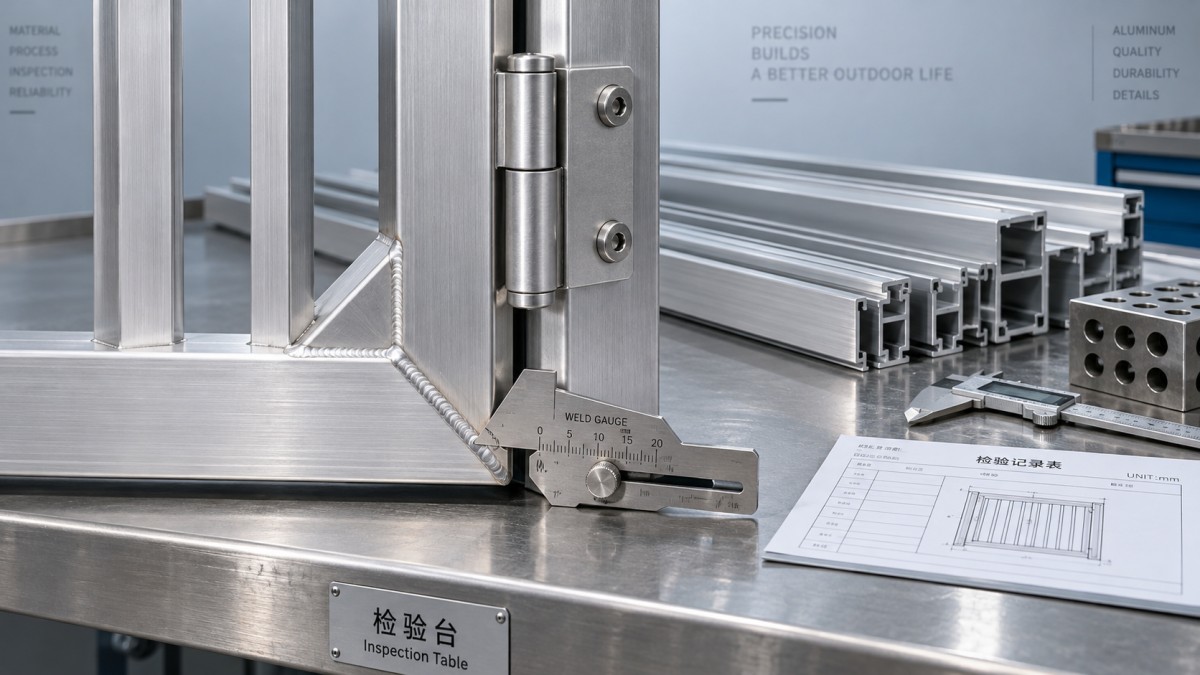
Request close-up, uncoated photographs of representative frame corners, hinge or carriage attachments, and repaired weld areas. Include a scale where weld size is important. These photographs support inspection, but they do not replace measurements or a qualified examination.
If additional testing is justified, agree on it before production. Dye penetrant testing can reveal surface-breaking defects but cannot establish internal weld quality. Other nondestructive methods need to be selected for the joint geometry, thickness, and defect types of concern by a competent specialist.
Also ask what happens when a defect is found. The answer should cover defect removal, repair controls, reinspection, and records—not simply “we polish it again.”
Will grinding and coating hide a fabrication problem?
Ornamental gates often require smooth transitions at visible joints. That makes finishing a procurement issue as well as an aesthetic one. Excessive grinding can remove weld metal or thin the adjacent profile, particularly at corners. Ask which welds may be dressed and how the supplier ensures the required joint section remains intact.
The coating specification should identify surface preparation, pretreatment, coating type, color, texture, and the inspection criteria appropriate to that system. “Powder coated” does not describe the entire process. Consistent preparation and curing matter to coating performance, especially around welds, edges, and recesses.
For hollow members, clarify how water drainage, process venting, and end closures are addressed. Aluminum does not develop red rust like steel, but it is not immune to corrosion. Dissimilar-metal hardware also deserves attention: ask whether isolation or other protective measures are needed for the intended environment.
Agree on an appearance sample if the entrance is visually prominent. A hotel buyer, for example, may care about weld visibility at pedestrian eye level more than a photograph taken from across the driveway would suggest.
Make competing quotations comparable
The lowest unit price is meaningful only when the quotations cover the same scope. Separate the gate structure, finish, hardware, automation, packing, and installation support so omissions are visible.
There is no universal price premium for a well-fabricated gate. Cost changes with dimensions, ornament complexity, material selection, finish, inspection requirements, and order quantity. For repeat orders, an approved first article can reduce uncertainty. It also gives both parties a physical reference for workmanship without replacing written specifications.
A product listing is a starting point, not the purchase specification
When reviewing Aluminum Art’s Thickened aluminum alloy courtyard gate, electric sliding gate, use the listing to open a technical discussion rather than treating every field as a confirmed gate specification.
The LX-1046 information references aluminum alloy construction, a 2.0 mm profile thickness, and hotel use. Ask which component the stated thickness applies to and whether the proposed frame suits your opening, infill, duty cycle, and wind conditions. Obtain a project-specific drawing showing the actual load-bearing sections and hardware attachments.
Some supplied fields refer to thermal-break profiles, seals, screens, and inward-tilting operation—features more commonly associated with window or glazed-door systems. Procurement teams should confirm which, if any, apply to this gate configuration. The listed hardware brand should likewise be verified against the hardware actually supplied.
The information also mentions a warranty exceeding five years and support options. Request written terms defining coverage for the structure, coating, moving hardware, and any automation, along with exclusions, claim procedures, and responsibility for freight or labor. A broad support statement is useful only when its practical scope is clear.
Set a release-to-ship checkpoint
Before placing the order, specify what must be accepted before dispatch. For most wrought aluminum gates, the release package should include approved drawings, material records as agreed, critical dimensional measurements, pre-coating inspection records, finish checks, and photographs of the completed assembly.
Where practical, ask for a trial assembly or operational demonstration. Identify exactly what was tested: a gate moving in the factory does not prove that the site foundations, motor selection, or installed safety devices are adequate. Automated gates need a separate safety and commissioning plan under applicable local requirements.
Packaging should protect the finish and prevent bending during lifting and transport. Confirm lifting points, component labeling, installation instructions, and the parts list before the shipment leaves.
Aluminum Art describes a manufacturing business covering courtyard doors, railings, stair handrails, and related accessories, with a stated emphasis on quality and service. Buyers can turn that emphasis into practical commitments: documented fabrication details, agreed inspections, clear delivery scope, and responsive handling of discrepancies.
The most reassuring purchase is not the one with the most polished sales photograph. It is the one whose construction can be explained, whose acceptance criteria are agreed, and whose delivered condition can be checked before the installation team is waiting at the entrance.
Related Posts
CONTACT US

First class quality service and professional after-sales team.
Get in Touch
*We respect your confidentiality and all information are protected.