


Aluminum Door Accessories: Planning Spare Parts for Multi-Site Maintenance
A technician arrives at a site with a replacement hinge, only to find that its fixing pattern does not match the door. Meanwhile, another location has several unused hinges but no compatible latch. Across multiple sites, these gaps turn routine maintenance into repeat visits, delayed repairs, and purchases that do not resolve the original fault.
A workable spare-parts plan for aluminum door accessories starts with verified compatibility, then separates parts by service urgency and replacement demand. Keep essential, confirmed-fit items close to the doors they support; pool expensive or rarely used components centrally; and set replenishment triggers using actual consumption and delivery lead times. Stock quantity matters, but a reliable record of what fits each installed door matters first.
Build the inventory around installed doors, not supplier descriptions
Descriptions such as “aluminum door hinge” or “replacement handle” are too broad for maintenance purchasing. Similar-looking components can differ in spindle dimensions, screw spacing, handing, load capacity, or profile attachment. Before consolidating stock across sites, create an installed-door register and connect each door family to a verified parts list.
Assign each door a site-specific asset reference. Record its manufacturer and model where available, opening arrangement, approximate leaf dimensions, hardware markings, and installation location. Include whether the door is manual or powered, exposed to weather, or part of a controlled-access route. These details help distinguish a convenience repair from a failure that affects security or safe operation.
- Hinges: Record the hinge type, fixing arrangement, adjustment range, handedness where relevant, and the approved application for the door leaf.
- Locks and handles: Capture the lock case dimensions, backset, faceplate size, spindle interface, fixing centers, and cylinder arrangement.
- Seals: Identify the cross-section, retaining groove, material, and installed position. A similar width does not establish compatibility.
- Sliding hardware: Note the roller assembly, track interface, adjustment mechanism, and the door system it supports.
- Powered assemblies: Record component references and relevant electrical interfaces from the equipment documentation, rather than relying on appearance.
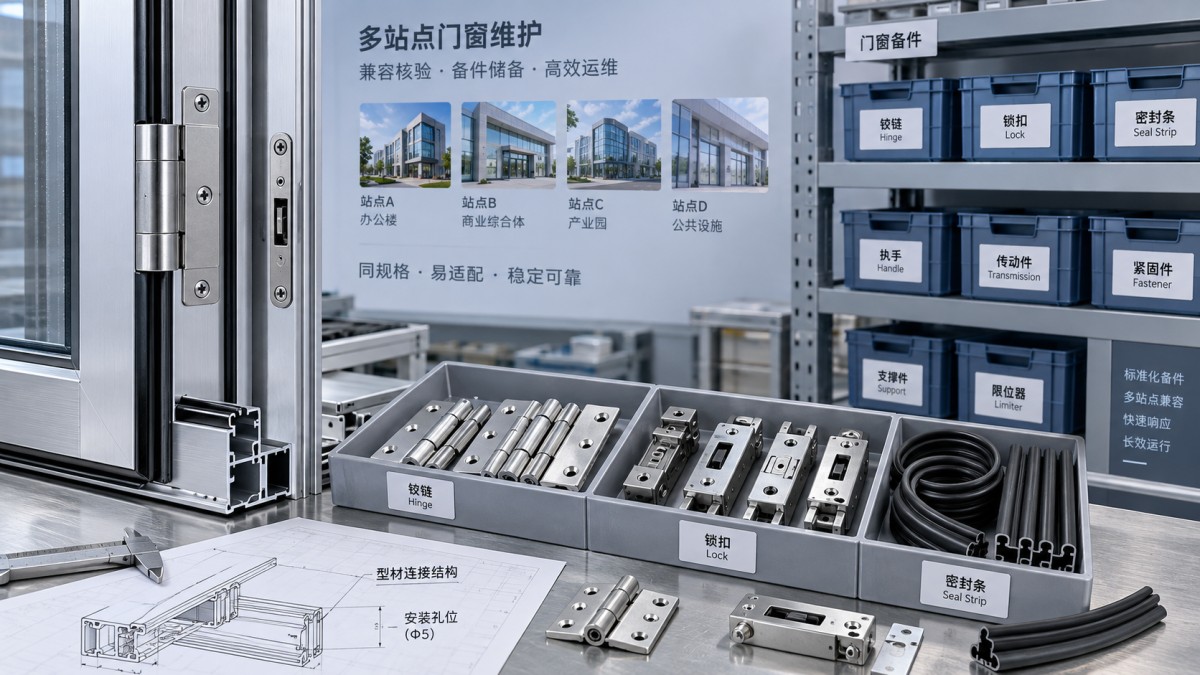
Use photographs alongside measurements: one image showing the installed component, one showing its markings, and one showing the mounting interface. When identification remains uncertain, label the proposed replacement as unverified. It should not become an approved substitute simply because it appears in a supplier search result.
Resolve configuration differences before creating shared stock
Multi-site standardization works only when components are genuinely interchangeable. A common finish or the same overall door material does not make two installations equivalent. Separate the visible product name from the exact hardware configuration, particularly when a listing describes several opening arrangements or optional assemblies.
For example, the supplied information for Aluminum Alloy Chinese Style Electric Courtyard Gate, model LX-1032, references aluminum-alloy construction, thermal-break profiles, EPDM seals or silicone sealant, 304 diamond mesh, optional fixed and sliding screens, and SOBINCO hardware. It also describes inward-tilt functionality. For spare-parts planning, these details are leads for identification—not proof that every listed feature applies to every supplied assembly.
Confirm the installed configuration against the order record, hardware schedule, or manufacturer’s technical response before stocking replacements. A screen roller, tilt mechanism, and gate component belong to different maintenance groups even when they appear under the same product listing. The distinction between a replaceable EPDM gasket and an applied silicone sealant also changes how the item is purchased, stored, and used.
The supplied product information mentions online technical support, free spare parts, returns and exchanges, and a warranty exceeding five years. Verify eligibility, coverage, identification requirements, and delivery arrangements before treating those provisions as part of the replenishment plan. A possible warranty replacement should not be counted as available stock until its supply is confirmed.
Separate urgent failures from high-volume replacements
Replacement frequency alone is a poor stocking rule. A frequently replaced cosmetic cover may have little operational impact, while a rarely replaced locking component can leave an entrance unsecured. Assess both demand and the consequence of waiting.
Apply these groups to actual installations rather than entire product categories. A handle may be an urgent item at one site and a scheduled repair at another, depending on its function and the condition of the remaining assembly. Powered-door safety devices should not be bypassed to keep an entrance running while a replacement is unavailable.
Also review exposure and usage. Outdoor hardware, heavily used entrances, and doors subject to repeated impacts may need different reserves. Use maintenance records to establish those differences; do not assume that every site needs an identical kit.
Set reorder points using demand during the delivery window
For each approved stock item, use a consistent unit of issue: a complete assembly, individual component, seal length, or packaged set. Mixing units makes consumption history unreliable. Record replacement demand separately from unused parts returned by technicians.
Reorder point = expected consumption during replenishment lead time + safety stock. Lead time should cover the complete interval from an approved request to usable stock on the shelf, including supplier processing, transport, receiving inspection, and any compatibility confirmation still required.
Base expected consumption on recorded issues over a relevant period. For recently installed doors with little history, begin with a provisional allowance informed by the installed population, criticality, and supplier availability. Mark it as provisional and review it as work orders accumulate rather than presenting an estimate as measured demand.
Safety stock should reflect uncertainty. Variable delivery times, irregular demand, remote sites, and limited transfer options justify a different reserve from a stable, easily replenished item. When calculating a purchase trigger, use the inventory position: usable stock plus confirmed incoming supply, minus quantities already allocated to jobs. Quarantined or damaged parts do not count.
Set an upper stock limit as well. Large purchases can leave obsolete hardware on the shelf after a door replacement program. Before reordering a slow-moving component, check whether the supported door family is still installed and whether a revised part has superseded it.
Choose where stock belongs—and make transfers visible
A central store reduces duplication, but it can delay repairs when travel or dispatch is difficult. Fully decentralized stock improves access but makes overstocking and unnoticed shortages more likely. A hybrid arrangement usually gives maintenance teams more control: small site reserves for urgent confirmed-fit items, with shared stock for less frequent repairs.
Choose the arrangement using realistic transfer times. A component held at another location is only useful if someone can authorize, pick, transport, and receive it within the acceptable repair window. Include out-of-hours access where the entrance must remain serviceable outside normal working hours.
Control technician kits as inventory locations
Van stock and portable repair kits should have their own records. Otherwise, a central system may show parts as available even though they are scattered among vehicles or already used. Build kits around assigned door families rather than filling every vehicle with loosely related accessories.
- Reserve the component against a work order before dispatch.
- Record its movement from the store to the technician or destination site.
- At job completion, identify what was installed, unused, defective, or removed for assessment.
- Return unused serviceable parts to a recorded location and replenish the kit from the confirmed issue.
Do not create demand twice by counting both a transfer and the eventual installation as separate consumption. Transfers change location; installation changes usable quantity. Keeping those events distinct makes site-level demand and total purchasing requirements easier to interpret.
Stop unnecessary replacement at the work-order stage
Spare-parts planning cannot compensate for weak diagnosis. A dragging leaf may reflect hinge adjustment, loose fixings, frame movement, or an obstruction rather than a failed hinge. A latch that misses its keeper may require alignment work rather than a new lock. Replacing the visible component without recording the cause can inflate demand and leave the fault unresolved.
Require a brief diagnostic record before issuing major assemblies. It should state the symptom, checks completed, failed component reference, and reason replacement is necessary. Where suitable, distinguish adjustment, cleaning, tightening, and component replacement as separate job outcomes.
After installation, check the relevant operating functions: full movement, secure closing, locking, clearance, and seal contact. For powered equipment, follow the manufacturer’s isolation and commissioning procedures and use appropriately qualified personnel. Inventory availability is not permission to improvise electrical connections, modify load-bearing hardware, or defeat protective functions.
Capture the removed part’s condition when failure is unusual or recurring. Repeated damage at the same door may call for correcting alignment, fixing support, or operating conditions rather than increasing the stock allowance. Keep suspect parts separate from usable returns.
Keep the parts library usable as installations change
Give every approved accessory an internal stock code connected to supplier references and compatible door assets. Maintain a substitution record with the evidence supporting interchangeability and any restrictions. “Fits most aluminum doors” is not enough to authorize a substitute.
Label storage bins with the stock code, description, unit of issue, and compatible door family. Protect seals from deformation and unsuitable storage conditions, keep matched hardware sets together, and preserve packaging that identifies revisions or handing. Follow supplier instructions for sealants with shelf-life limits, and check expiry before dispatch.
Review the stock plan after a new site is added, a door family is replaced, supplier availability changes, or repeated shortages occur. Compare urgent purchases, unused returns, repeat visits caused by wrong parts, and slow-moving inventory. These records show whether the problem is an inaccurate parts library, an insufficient reserve, or a diagnosis issue.
When retiring doors, remove their accessories from routine reorder lists and check whether remaining stock has a verified use elsewhere. Retain justified reserves for installations still in service, but do not replenish a component solely because its bin used to have a minimum quantity. The reorder rule should follow the installed equipment—not outlive it.
Related Posts
CONTACT US

First class quality service and professional after-sales team.
Get in Touch
*We respect your confidentiality and all information are protected.