


Aluminum Windows Price: What to Check Before Comparing Supplier Quotes
A low aluminum windows price is only useful when it covers the same window specification and delivery scope as competing offers. When one supplier quotes a complete glazed unit and another quotes frames without installation accessories, the lower total can hide costs that appear after the purchase order is issued. Compare dimensions, opening configurations, frame systems, glazing, hardware, finishes, and exclusions before ranking suppliers by price.
The practical starting point is a shared window schedule and a line-by-line scope comparison. Ask every supplier to price the same requirements, identify deviations, and separate optional upgrades from mandatory items. This makes differences visible before they become problems with approval, installation, weather resistance, or replacement parts.
Start with a window schedule, not a headline rate
A price per square meter can help with early budgeting, but it is not enough for a purchasing decision. A fixed window and an opening window of similar size require different hardware and fabrication work. Small units may also have a higher cost per square meter because locks, handles, corner assembly, and production handling do not decrease in proportion to glass area.
Give each window type a reference code and specify its quantity, overall frame dimensions, opening direction, configuration, and location. Distinguish frame size from the building opening size. Otherwise, suppliers may calculate different areas or allow different installation clearances while appearing to quote the same schedule.
- Configuration: Identify fixed, sliding, casement, tilt-and-turn, or other required arrangements, including combinations within one frame.
- Dimensions: State the measurement basis and identify sizes that still require site verification.
- Performance: Include project requirements for thermal performance, air leakage, water resistance, wind loading, and acoustics where applicable.
- Scope: Specify whether glazing, screens, subframes, flashings, installation materials, and installation labor are included.
Require suppliers to mark anything they cannot meet rather than silently substitute their standard system. Keep alternatives in a separate column so an economical option does not get mistaken for a compliant base offer.
Read the frame specification beyond “aluminum”
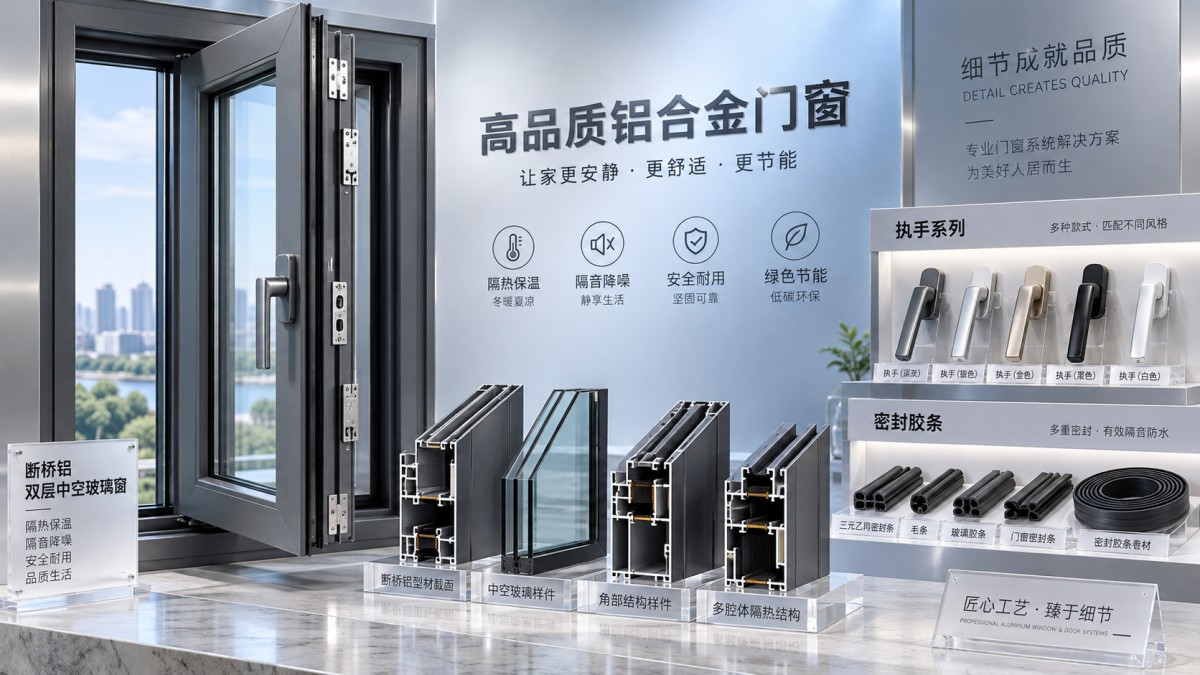
Two aluminum frames can look similar in a photograph while differing in profile geometry, wall thickness, reinforcement, drainage, and thermal-break construction. Ask for profile drawings and the proposed system reference. A statement such as “heavy-duty aluminum” does not provide enough information to verify suitability.
Profile depth and wall thickness matter, but neither should be judged alone. The frame must support the specified dimensions, glass weight, opening arrangement, and design loads. Increasing thickness everywhere is not a substitute for an appropriate system design. For large units or exposed elevations, obtain confirmation that the proposed configuration is within the system’s supported limits.
Separate thermal-break and non-thermal-break offers
A thermal-break frame interrupts the conductive path through the aluminum. It is not equivalent to a non-thermal-break frame fitted with insulated glass. Where the project has a thermal-performance requirement, compare whole-window values for the proposed configuration, not glass-only values or a generic claim about energy efficiency.
Ask which test or calculation supports the stated performance and whether it represents the quoted frame, glazing, and opening type. A result for a different unit size or fixed configuration may not establish the performance of the opening windows being purchased. Condensation risk also depends on indoor humidity and installation details, so a frame claim alone cannot resolve every condition.
At the frame-to-wall interface, establish who supplies subframes, anchors, perimeter seals, sill details, and drainage provisions. These are easy to omit from a factory quote, yet they affect both installation cost and the completed window’s performance.
Make the glazing description complete
“Double glazing” is not a complete specification. Obtain the glass build-up, pane thicknesses, cavity arrangement, coating specification, spacer type, and gas fill if required. Safety glass, laminated glass, acoustic options, and solar-control coatings can change cost substantially, but the correct selection depends on the opening’s location and project requirements.
For thermal comparisons, distinguish whole-window U-value from center-of-glass U-value. Also check solar heat gain and visible light transmission where these affect the design. A lower U-value does not automatically make every glazing package the best choice; solar exposure, shading, and daylight requirements may call for a different balance.
Request documentation tied to the proposed glass build-up. Where safety glazing is required, the project specification or qualified design team should establish the applicable requirements. Do not accept a cheaper substitution simply because its thickness matches: tempered and laminated constructions serve different purposes.
Hardware and finishes need identifiable specifications
An opening sash depends on its hinges, rollers, locks, handles, and seals. Ask for the hardware series, load capacity where relevant, locking arrangement, and compatibility with the sash dimensions and weight. If a supplier proposes equivalent hardware, require enough detail to evaluate that equivalence before approval.
Check maintenance access and replacement availability as well. Hardware that can only be replaced by dismantling adjacent finishes may create avoidable service costs. For sliding units, clarify roller adjustment and track drainage; for hinged units, confirm the proposed hardware can support the glass package.
Finish descriptions should identify the treatment, color reference, gloss or texture, and the coating specification appropriate to the exposure. “Powder coated” alone leaves important differences unresolved. Coastal or otherwise aggressive environments require a deliberate finish selection rather than an assumption that every aluminum coating offers the same protection.
Approve a physical finish sample when appearance matters, and establish how acceptable variation will be judged. Clarify whether exposed accessories match the frame and whether protective film is suitable for the expected storage conditions. Surface damage during handling can turn a low purchase price into a costly replacement exercise.
Convert every offer to the same delivered scope
Once technical deviations are visible, normalize the commercial comparison. Choose a common endpoint, such as delivery to the project receiving area, and identify costs required to reach it. Keep uncertain amounts flagged as estimates instead of treating them as confirmed supplier charges.
A useful calculation is: comparable project cost = quoted supply cost + excluded mandatory items + delivery and handling + required installation scope + applicable taxes or duties. Include only costs relevant to the chosen comparison boundary, and avoid adding something twice when it is already included in the supplier’s price.
Keep optional enhancements separate from the compliant base cost. This lets the team decide whether an upgrade is worth buying without confusing that decision with the price of meeting the specification.
Keep adjacent aluminum products outside the window benchmark
A combined exterior package may include windows, gates, and fencing. If the scope includes the Aluminum alloy fence, model GFR-13, listed for commercial and residential applications, request a separate line item and acceptance criteria. Its listed design and durability attributes do not establish window performance. Separating these categories prevents a package discount from obscuring the actual cost of the window schedule.
Check what happens between approval and delivery
Lead time should have a defined starting point. Ask whether production begins after deposit, drawing approval, final measurements, finish confirmation, or material availability. A short quoted lead time is difficult to use if these prerequisites are unresolved.
Request a sequence for drawing submission, sample approval, fabrication, inspection, packing, and shipment. Where delivery is phased, specify which window references belong to each shipment. Missing units or unidentified packages can disrupt installation even when most of the order arrives on time.
Quality commitments should describe verifiable actions. Discuss dimensional checks, operating checks, finish inspection, glazing inspection, and packaging inspection, with acceptance criteria agreed before production. Test evidence and production checks serve different purposes: neither should be assumed to replace the other.
For projects requiring mock-up testing or performance verification, establish responsibility and cost before award. Also agree on the process for reporting transport damage, incorrect dimensions, missing accessories, and nonconforming finishes. Define what evidence is needed and who arranges repair or replacement.
Turn the warranty into a usable purchasing term
A warranty duration alone does not explain the protection offered. Ask which components are covered, what failures qualify, when coverage begins, and whether labor, removal, reinstallation, and replacement freight are included. Frame finish, hardware, and insulated glass may have different conditions.
Review exclusions that relate to installation, maintenance, exposure, and storage. If installation is performed by another contractor, clarify how responsibility for leaks or operating problems will be determined. Otherwise, a defect may become a dispute between the supplier and installer instead of a timely repair.
Spare-parts availability deserves a separate answer. Obtain hardware references and ask how replacement seals, rollers, handles, and glazing components can be ordered. This is especially relevant where multiple phases need consistent components over time.
Resolve the cheapest quote’s gaps before awarding
When an offer is substantially lower, ask the supplier to explain the difference against the shared schedule. It may reflect a simpler configuration, excluded freight, different glass, or a genuine production advantage. The price difference itself does not prove either poor quality or better value.
- Record each technical deviation, missing document, and commercial exclusion against the relevant window reference.
- Request a revised quotation that prices mandatory corrections and keeps optional alternatives separate.
- Confirm drawings, delivery obligations, acceptance criteria, and warranty responsibilities in the order documents.
Do not award on an assumption that unresolved details will be settled later at no extra cost. A supplier that cannot identify the quoted system, substantiate required performance, or define delivery scope has not yet provided a comparable offer. Keep that bid conditional until the missing information is resolved, even if its initial total is the lowest.
Related Posts
CONTACT US

First class quality service and professional after-sales team.
Get in Touch
*We respect your confidentiality and all information are protected.