


Copper Aluminum Doors: Real Copper Cladding or a Copper-Look Finish?
A copper-colored door is not necessarily a copper-clad door. “Copper aluminum doors” can describe an aluminum door faced with genuine copper sheet, an aluminum door with a copper-effect coating, or a construction combining metallic layers and decorative treatments. The name alone does not establish what is being supplied, and quotations using that name may cover materially different products.
The purchasing decision should turn on whether the project requires copper as a material or only its appearance. Genuine copper cladding introduces specific fabrication, weight, corrosion-isolation, and maintenance requirements. A copper-look finish can meet a visual brief without those same requirements, but its suitability depends on the coating system, exposure conditions, and acceptable changes in appearance—not simply how convincing a showroom sample looks.
Establish what “copper” means in the quotation
A useful specification separates the structural door from its decorative surface. The aluminum frame, panel assembly, reinforcement, insulation, hardware, and seals form one part of the purchase. The facing material and its treatment form another. Neither a copper-colored surface nor genuine copper sheet proves that the complete door has adequate weather resistance, security, or thermal performance.
Descriptions such as “copper finish,” “antique copper,” and “bronze copper color” identify appearance, not construction. Even “copper surface” remains ambiguous without a material schedule. Require the supplier to identify whether the surface is solid copper sheet, deposited copper, copper-containing paint, or a non-copper decorative coating.
Coverage also matters. A door may have copper only on the exterior face, with coated aluminum on the interior, edges, frame, and decorative components. That can be a legitimate design, but it should not be priced or accepted as though every visible surface were copper-clad.
A finish sample cannot verify the complete construction
A flat color sample is useful for approving shade and texture. It does not show how a supplier handles folded edges, joints, drainage openings, hardware penetrations, or contact between dissimilar metals. For genuine cladding, request a representative corner or section sample showing the copper skin, backing, attachment method, and edge treatment.
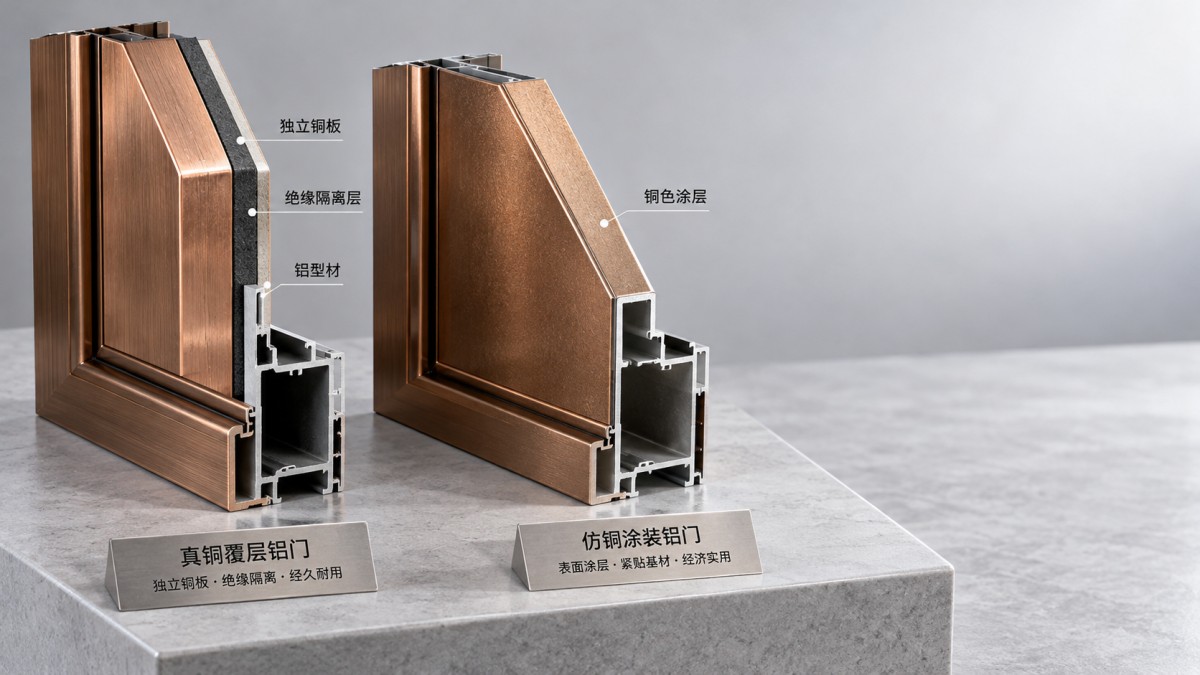
The sample should correspond to the proposed production construction. A thick copper display piece says little about a door made with thinner facing material. Equally, a coating applied to an ideal laboratory panel does not demonstrate how the finish will cover cast ornamentation, weld areas, or recessed details.
Material records and production traceability provide stronger evidence than color alone. Ask for the copper material designation and supporting supply documentation, then connect those records to the order. Where the material premium justifies independent inspection, a qualified inspector can select appropriate identification and thickness checks. Surface analysis alone may detect copper without proving that a substantial copper sheet is present; the verification method must match the claim.
Magnet tests are not a useful way to distinguish copper sheet from coated aluminum because neither base metal is ferromagnetic. Scratching a finished door is also an unreliable acceptance method: it damages the product and may reveal only one layer of a multilayer system.
Compare costs on the same door assembly
Genuine copper sheet adds a material cost that a copper-colored coating does not. It also requires forming, edge detailing, attachment, and protection during fabrication and transport. The effect on the final price depends on sheet thickness, covered area, decorative complexity, and the underlying door construction. There is no dependable universal percentage premium.
Weight is another cost variable. Copper is substantially denser than aluminum, so adding a copper skin increases leaf weight. The relevant question is not whether the door feels “solid,” but whether hinges, pivots, rollers, operators, and fixing points are selected for the completed assembly. Hardware upgraded for the extra load can change both purchase cost and replacement cost.
Request separate quotations using the same dimensions, panel core, frame profiles, hardware, seals, glazing, and installation scope, with only the decorative construction changed. Otherwise, a cheaper copper-look option may also contain lighter profiles or lower-specification hardware, making the apparent finish saving misleading.
The comparison should include:
- The supplied door set, including frame, threshold, hardware, and any automation.
- Packing and freight based on finished dimensions and shipping weight.
- Installation requirements, including handling and site adjustment.
- Approved cleaning, protective treatment, and foreseeable refinishing work.
- The cost and availability of matching replacement panels or complete leaves.
Distinguish metal thickness from assembly thickness. A quotation describing a thick “door panel” may refer to the complete insulated panel, not the copper skin. Copper sheet thickness and aluminum wall thickness should appear as separate values with agreed tolerances.
The desired appearance determines the maintenance burden
Uncoated copper changes appearance through oxidation and exposure. Its color progression depends on moisture, pollutants, handling, orientation, and local conditions. A sheltered entrance may age differently from an exposed gate, and adjacent leaves can develop differently if rain or sunlight reaches them unevenly. A uniform green patina should not be assumed within a predictable period.
That evolution can be part of the architectural intent. If the requirement is a bright, polished copper appearance, however, natural weathering becomes a maintenance issue rather than a design benefit. Clear protective coatings can slow surface change, but their effectiveness and service life depend on preparation, coating selection, exposure, and damage.
Pre-patinated copper also needs an approved appearance range. It should not be specified as an indefinitely fixed color unless the supplier has a defined treatment system and supporting evidence. Handling marks, installation damage, and later repairs can remain visible against a decorative patina.
Copper-look coatings offer a different proposition: a defined decorative color without relying on copper oxidation. Metallic powders, liquid coatings, and multilayer decorative systems are not interchangeable. Their resistance to ultraviolet exposure, moisture, abrasion, and cleaning chemicals depends on the actual system. Require an exterior-grade specification where the door is exposed outdoors.
Repairability deserves attention before purchase. Local polishing can create a contrasting area on genuine copper; localized touch-up on a metallic coating can differ in gloss, particle orientation, or texture. For either option, ask whether the approved repair is a small-area treatment, full-face refinishing, or panel replacement.
Copper and aluminum require deliberate interface design
Genuine copper cladding on aluminum creates a dissimilar-metal interface. When the metals are electrically connected and moisture provides an electrolyte, galvanic corrosion can attack the less noble aluminum. The risk depends on the detailed assembly and exposure, not merely on whether both metals appear in the product.
A credible construction therefore needs a defined separation strategy. This may involve suitable insulating layers, compatible bonding systems, isolated fasteners, and drainage details. The important evidence is a section drawing that shows how those measures remain effective at edges, joints, and penetrations—not a general statement that the door is “anti-corrosion.”
Copper-bearing runoff reaching exposed aluminum also deserves assessment. Drainage should avoid directing that water onto vulnerable aluminum components. Coastal locations, frequent wetting, and chloride exposure place greater demands on the design, so installation conditions should be disclosed before the supplier proposes a system.
Differential thermal movement is another consideration. Copper and aluminum do not expand at identical rates. Large cladding areas, especially on sun-exposed doors, need attachment details that accommodate movement without unacceptable distortion or loss of adhesion. Ask how the proposed construction manages this rather than prescribing a bonding method without design evidence.
Do not confuse decorative specifications with door performance
A copper surface does not establish insulation quality, air leakage, water resistance, security, or operating reliability. These depend on the complete door set. A thermally broken frame, for example, does not by itself establish the thermal performance of the panel, threshold, glazing, and installed assembly.
This distinction is visible in listings such as the Aluminum Electric Sliding Door, model LX-1063, which describes aluminum-alloy construction, thermally broken profiles, and EPDM or silicone sealing materials, while the surface treatment is stated only as “Completed.” Those details do not identify genuine copper cladding or a particular copper-look coating. A finish-specific material schedule would still be necessary before using such a listing to satisfy a copper appearance requirement.
Performance documentation should relate to the offered configuration, including size, opening arrangement, glazing, hardware, and threshold. A report for a different door family should not be treated as proof for the proposed assembly without a defensible basis for its applicability.
For finish durability, request test methods, results, and the identity of the tested coating system or clad construction. A statement such as “salt-spray tested” is incomplete without exposure conditions, duration, acceptance criteria, and specimen details. Accelerated corrosion testing can support comparison, but it is not a direct prediction of years of service.
Make the purchase order resolve the ambiguity
The purchase order should convert the approved appearance into a reproducible construction. Attach a material schedule, relevant section drawings, and an approved reference sample. Define which surfaces are clad or coated, the permitted appearance variation, and the inspection conditions. Metallic finishes need agreed viewing conditions because lighting and viewing angle affect perceived color.
For genuine copper, record the material designation, nominal thickness and tolerance, backing, attachment method, isolation provisions, and whether the surface is untreated, patinated, or clear-coated. For copper-look finishes, record the substrate preparation, coating system, target color and texture, specified film thickness, and any protective topcoat.
A preproduction assembly can resolve questions that a small sample cannot: edge appearance, joint alignment, hardware fit, panel flatness, and consistency across differently shaped parts. For larger orders, agree on batch controls and inspection timing before dispatch, when a correction is still practical.
Warranty terms should distinguish structural defects, hardware failures, coating defects, and expected copper weathering. An allowance for natural patination must not become a blanket exclusion for adhesion failure, corrosion caused by defective interfaces, or damage present at delivery. Likewise, a long general warranty is of limited value if the decorative finish is excluded.
Choose genuine copper when the specification requires the material itself and the project accepts its weight, detailing needs, and appearance evolution. Choose a copper-look finish when controlled color and budget are the governing requirements, provided its documented durability suits the exposure. If copper is mandatory, a color match is not a substitute; if only the color is required, paying for copper sheet may add cost without solving a project need.
Related Posts
CONTACT US

First class quality service and professional after-sales team.
Get in Touch
*We respect your confidentiality and all information are protected.