


Casement Window vs. Sliding Window: Ventilation and Clearance Compared
A casement window is generally the stronger choice when you want a large ventilation opening from a relatively narrow frame. A horizontal sliding window is the better fit when an outward-opening sash would obstruct a patio, walkway, balcony, or nearby planting. The practical trade-off is opening area versus swing clearance—not simply which style looks better.
For the comparison here, a casement window is a side-hinged, outward-opening window, while a sliding window has sashes that move horizontally within the frame. Inward-opening and tilt-and-turn designs need a different clearance assessment. Your decision should account for how far the window can actually open, where the breeze comes from, and whether you can comfortably operate it in its installed position.
Ventilation: compare the usable opening, not the glass size
When fully opened, a casement sash moves out of the frame and leaves much of its opening available for airflow. A conventional two-panel slider, with one panel moving past the other, opens roughly half its overall width. Frame members, sash overlap, screens, and opening stops reduce the clear opening further.
This gives the casement a geometric advantage when comparing similarly sized units. It does not mean every casement delivers twice the airflow of every slider. Air movement also depends on wind pressure, indoor-to-outdoor temperature differences, the screen, and whether air has somewhere else to exit.
Consider two windows with the same overall width and height. If the casement can open widely but the slider exposes only one side of its frame, the casement provides a larger potential air passage. If the casement is restricted to a small opening angle, however, that advantage shrinks. A wide slider may also provide more usable opening than a much smaller casement.
For a meaningful comparison, ask for the clear ventilation opening at the opening position you will actually use. Overall frame dimensions and glass area do not answer that question. This is particularly important where safety restrictors, adjacent walls, or exterior obstacles limit casement travel.
A casement can redirect a breeze—but orientation matters
An open casement sash can act as a wind deflector. With a favorable wind direction and hinge arrangement, it can help guide moving air into a room. With an unfavorable arrangement, the same sash can shelter the opening from the breeze. Choosing left-hand or right-hand hinges can therefore affect more than appearance.
A slider does not project a sash outward to redirect wind. Its airflow depends more directly on the pressure difference across the opening. That makes it less able to capture a breeze moving along the wall, but avoids placing a projecting sash in the wind.
Neither design creates dependable cross-ventilation on its own. A second opening on another side of the home, or another suitable airflow path, can be more important than changing the window style. A large opening into a room with a closed door and no effective outlet may deliver less air movement than expected.
Screens and opening limits can change the result
Insect screens add resistance to airflow. Mesh density, wire thickness, and the proportion of open space all matter. A robust security mesh should not be assumed to pass air as freely as a lighter insect screen. Compare screen specifications where available rather than judging ventilation from the window frame alone.
Also check whether the screen permits the intended operation. Outward-opening crank-operated casements commonly use an interior screen; other operating arrangements may need a different screen solution. Sliding windows can use fixed or movable screens, depending on their configuration. The screen should remain practical to remove, clean, and secure without forcing you to use a smaller opening.
Clearance: a casement needs a swept area, not just a gap
A sliding window keeps its moving sash within the frame, so it does not need an exterior swing zone. This is its clearest advantage beside circulation routes or confined outdoor spaces. You can open it without projecting a glass panel into the area immediately outside.
A casement needs space throughout the sash’s movement. At approximately 90 degrees to the frame, its outward projection is roughly related to the sash width, although hinges and hardware alter the exact geometry. The sash must also clear obstacles at intermediate angles—not just at its final open position.
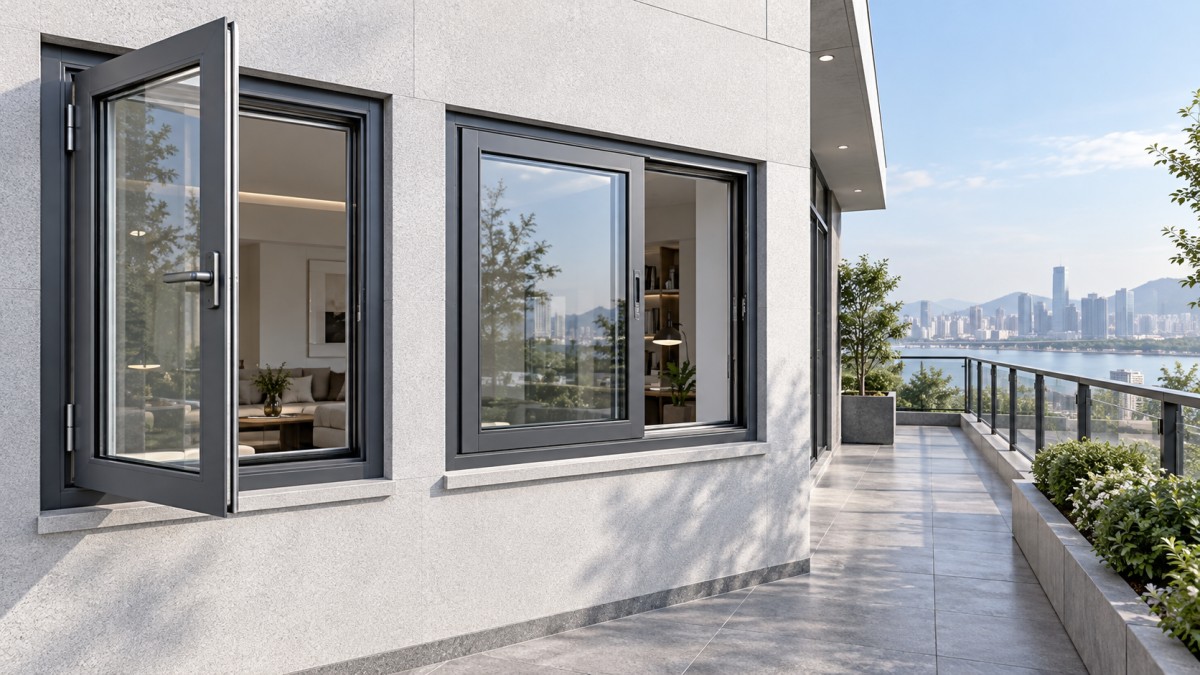
Measure from the installed window position to the nearest obstruction, allowing for handles, hardware, and the full sash path. Deep exterior reveals can restrict movement even when the space beyond the wall appears open. A perpendicular wall, fence, downpipe, shutter, or planter can also stop the sash before it reaches the intended angle.
On a patio, assess the window with chairs occupied and furniture in its normal position. Beside a walkway, consider the remaining passage width when the sash is open. A window that technically clears a railing may still put its edge at shoulder or head height along a frequently used route.
Do not count on moving furniture every time you want fresh air. If the layout makes full opening inconvenient, the practical ventilation performance will be lower than the product’s maximum opening suggests.
Above a kitchen counter, operating reach can decide the choice
A window over a sink illustrates why clearance and usability should be considered together. An outward-opening casement does not swing into the room, and a crank positioned near the bottom of the frame may be easier to reach than a sliding sash handle. This can be useful when a deep counter separates you from the window.
However, check the actual hardware position. A crank can conflict with a tall faucet, backsplash, or objects on the sill. Locks positioned higher on the frame may still be difficult to reach. A folding handle reduces its projection when stored, but does not solve an inaccessible locking point.
A slider avoids exterior swing conflicts, yet moving the sash requires a sideways push or pull. A wide, heavy sash may be awkward to operate while leaning over a counter. Hardware quality, sash weight, track condition, and installation alignment all affect the effort required.
The useful test is not whether either window operates smoothly in a showroom at waist height. It is whether you can reach its handle and locks from your actual standing position. For an over-counter installation, use the proposed sill height and counter depth when checking operation.
Bedrooms and living rooms: match the opening to everyday use
In a small bedroom with clear space outside, a casement can provide a generous ventilation opening without increasing the frame size. It can be particularly useful when the available wall opening is narrow. But curtains, interior screens, and access to the operating handle still need attention.
In a living room overlooking a busy deck, a slider often preserves the outdoor layout more effectively. Furniture can remain close to the wall without occupying a sash swing zone. That benefit may outweigh the smaller opening, especially if the room already has another ventilation route.
For wide windows, compare the complete assembly. A central fixed pane with two opening casements is not equivalent to an all-operable unit. Likewise, a three-panel slider may have a different opening arrangement from a basic two-panel slider. Ask which panels move, where they park, and how much unobstructed opening remains.
If the window must serve as an emergency escape opening, treat that as a separate requirement. Local rules may address net clear opening, dimensions, sill height, and operation. Neither “casement” nor “sliding” automatically establishes compliance. Screens, restrictors, and security devices also need to be considered.
Do not confuse weather sealing with open-window airflow
Casements commonly use compression seals: closing and locking the sash presses it against the weather seals. Sliding windows use seals that accommodate movement along the track. This difference can influence closed-window air leakage, but it does not establish the performance of a particular product.
A well-made slider can outperform a poorly specified or poorly installed casement. Compare tested air-leakage performance for the actual window configuration, along with installation requirements. Frame material, thermal breaks, and glazing affect comfort when the window is closed; they do not compensate for inadequate ventilation opening or an obstructed swing path.
Product descriptions also require careful reading. The listing titled Retractable gate, for example, includes an inward-tilting opening description and optional fixed or sliding screens. Those details are not enough to classify it as either window style compared here. An inward-opening configuration would shift the clearance concern indoors, so a drawing of the actual unit is more useful than its listing title.
For any proposed window, request the opening direction, hinge position, maximum opening angle, screen arrangement, and operating-hardware location. These details connect the specification to your room layout.
Choose the window you can comfortably leave open
A large theoretical opening has little value if wind, obstacles, or awkward operation prevent you from using it. An outward casement catches wind loads when open, so exposed locations require suitable hardware and adherence to the manufacturer’s operating guidance. A slider avoids the projecting sash, but it still admits wind-driven rain through an open aperture. Neither style should be treated as a rain-proof ventilation solution.
Maintenance access matters for continued usability. Sliding tracks need to remain clear so the sash can travel properly and drainage paths are not blocked. Casement hinges, operators, and locking points need appropriate care. Confirm how exterior glass can be cleaned from your particular installation; inward cleaning access is a product feature, not a guarantee attached to either style.
Choose a casement when ventilation from a limited frame area is the priority and the full outward swing is genuinely available. Choose a slider when keeping the exterior passage clear is more important, provided its usable opening and operating reach meet your needs.
Before ordering, mark the proposed sash projection outside, check the handle position inside, and obtain the clear-opening dimensions with the intended screen and restrictors fitted. Those checks reveal the decisive difference: not how far a window can open on paper, but how much fresh-air opening your layout allows you to use.
Related Posts
CONTACT US

First class quality service and professional after-sales team.
Get in Touch
*We respect your confidentiality and all information are protected.