


Portable Aluminum Pergola: Anchoring and Wind Limits for Temporary Use
Portable Aluminum Pergola: Anchoring and Wind Limits for Temporary Use
Setting up a portable aluminum pergola for temporary shade takes more than finding a level spot. Secure anchoring, suitable ground conditions, and manufacturer-specified wind limits help determine whether it can be used safely. If you are comparing aluminum pergola portable options, check how each model must be anchored and when its canopy must be retracted or the structure taken down. This guide explains what users and operators should verify before installation, how different surfaces affect anchoring choices, and why temporary use never removes the need to monitor changing weather.
The practical question is not simply whether the frame is light enough to move. It is whether the complete installation can resist uplift, sliding, and overturning in its intended location. A pergola that is convenient to transport may still need substantial anchoring. If the site cannot accommodate the specified anchoring system, it is the wrong site—or the wrong pergola—for that job.
Check what “portable” actually permits
Portable can mean a folding frame, a modular structure assembled with bolts, or a pergola that can be relocated after its anchors are removed. These are different arrangements. A rigid aluminum pergola with adjustable louvers should not be treated like a pop-up fabric shelter, even if a product listing describes both as portable.
Before unloading, obtain the installation instructions for the exact model and size. Look for permitted mounting surfaces, anchor specifications, any approved ballast arrangement, roof operating instructions, and weather restrictions. Check whether the stated wind performance applies to the assembled frame, the deployed roof, or a particular tested installation. A rating without its installation conditions is not a useful operating limit.
For hired or repeatedly relocated units, missing instructions should stop the setup. Photographs from the last installation do not establish that the previous arrangement was safe. Confirm that base plates, braces, locking pins, and fasteners are present and undamaged, particularly where repeated assembly can wear holes or threads.
Match the anchors to the ground—not just the base plate
Wind loads travel from the roof through the beams and posts into the anchoring system. Every connection along that path matters. Strong anchors cannot compensate for a loose beam connection, and a heavy base cannot make an unapproved post attachment reliable.
Concrete patios and forecourts
Concrete may allow a secure installation, but its thickness, condition, reinforcement, and distance from edges must suit the specified anchors. Decorative paving over a thin bedding layer is not equivalent to a structural concrete slab. Neither is an unknown slab automatically suitable because it looks solid.
Use the anchor type, embedment, spacing, and installation procedure required for the approved mounting detail. Check for concealed services before drilling and obtain the property owner’s permission. Where substrate information is unavailable, ask the supplier or a qualified installer to assess it rather than selecting bolts by diameter alone.
Lawns, soil, and gravel
Ground anchors depend on the soil they engage. Loose fill, saturated ground, and shallow soil over rock can behave very differently from firm undisturbed soil. An anchor that performed adequately at one event may be unsuitable after relocation or heavy rain.
Use stakes or screw anchors only where the pergola manufacturer permits them, with any required capacity verification. Do not substitute camping pegs for a structural anchoring arrangement. Gravel is especially misleading: the visible surface tells you little about the supporting ground below. Buried utilities must also be checked before driving or screwing anything into the ground.
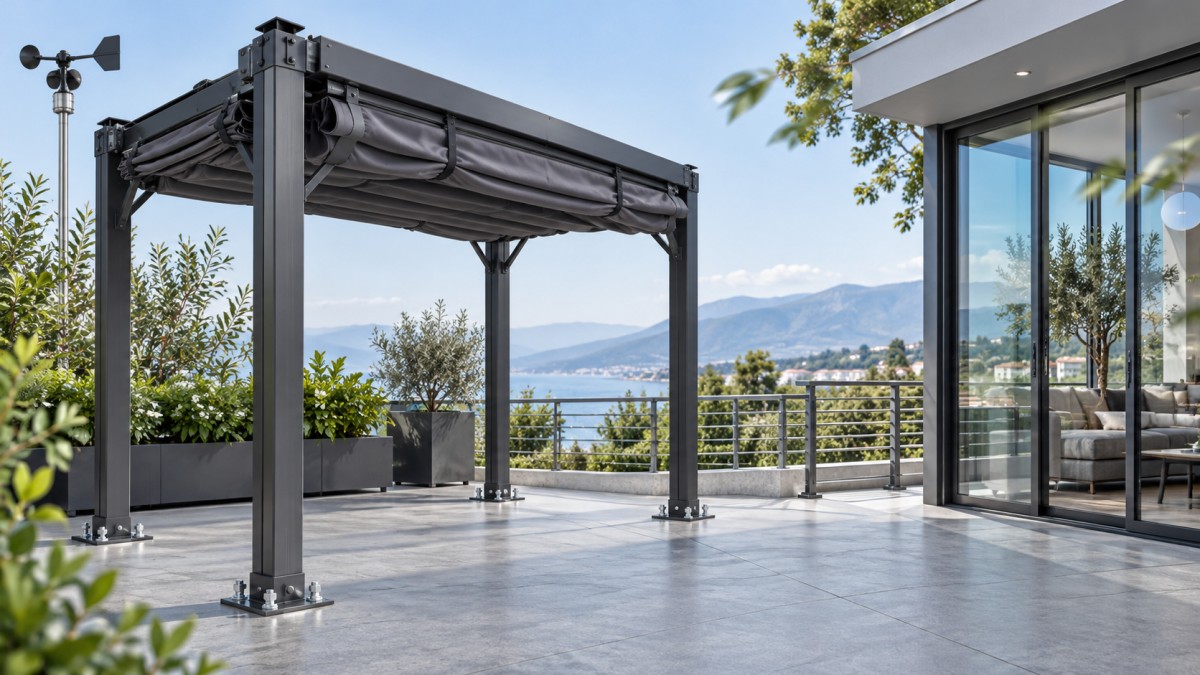
Decks, pavers, and sites where drilling is prohibited
Deck boards are not automatically suitable anchor points. Loads may need to transfer into joists or other supporting members, and the deck itself must be capable of carrying them. Likewise, fastening a post to an individual paving block can leave the whole block free to lift or shift.
If drilling is prohibited, ask whether the model has an approved ballast system. Its required mass, placement, attachment method, and supporting surface capacity must be established for the installation. There is no responsible universal answer to “How much weight per leg?” Water containers, concrete blocks, and sandbags are not interchangeable simply because their weights match.
Ballast must be securely connected as specified, not merely placed beside the posts. It also takes up usable space. At a café entrance or courtyard event, a technically suitable base can still create an unacceptable trip hazard or obstruct a doorway.
Read wind limits as operating conditions
There is no single safe wind speed for every portable aluminum pergola. Dimensions, roof design, bracing, anchoring, exposure, and installation quality all affect performance. Avoid borrowing a limit from a similar-looking product or assuming that aluminum construction itself establishes wind resistance.
Distinguish between a structural wind rating and the conditions under which people may use the pergola. A published resistance value may depend on a specified foundation and roof position. It may not permit occupancy, canopy operation, or temporary ballasted installation at that wind speed.
The instructions should answer three practical questions:
- What wind conditions require use to stop?
- When must the canopy be retracted, removed, or placed in a specified position?
- When must the structure be dismantled, and how much advance time does that require?
Do not assume retracting fabric or opening louvers makes every structure safe. Different roof systems have different prescribed storm configurations, and the exposed frame still receives wind load. Follow the model-specific instructions. If those instructions are unclear, obtain clarification before use rather than improvising a storm setting.
Wind pressure increases approximately with the square of wind speed, so a modest increase in speed can produce a much larger load. Gusts also matter. A forecast average is not enough if the stated operating limit concerns gust speed. Match the forecast information to the manufacturer’s definition, including units and measurement conditions.
Doorways, fences, and courtyard layouts change the decision
A sheltered-looking courtyard is not necessarily a low-wind site. Openings between buildings can channel airflow, while corners and roof edges can create localized turbulence. Leave room for doors and gates to open fully, and keep the pergola clear of exit routes, glazing, and equipment access. Consider where loose components could travel if something fails.
A nearby fence is a boundary, not a ready-made anchor. For example, the aluminum LX-1082 Aluminum alloy fence is intended for residential and commercial applications, but its presence does not establish permission or capacity to support pergola loads. Keep the two systems independent unless a qualified design specifically connects them.
The same caution applies to courtyard gates, guardrails, and stair handrails. Aluminum Art manufactures these building components alongside doors and accessories; that broader context highlights why connection details and precise fit matter. A railing designed for its own service conditions should not be repurposed as a pergola restraint without assessment. Convenient installation is valuable only when the supporting construction is suitable.
Side curtains, privacy screens, and banners deserve particular attention. They can increase wind exposure and change how loads reach the frame. Do not add them because the fixing points happen to be convenient. Verify that the accessory and its operating restrictions are covered by the manufacturer’s instructions.
Make the weather response workable before opening
For temporary use, assign someone to monitor the forecast and changing conditions. That person needs authority to close the area, not merely report concerns. A handheld anemometer can provide useful local information, but its reading depends on where it is held and should not replace forecasts, warnings, or the installation’s restrictions.
Set an action trigger early enough to complete the required procedure before unsafe conditions arrive. A canopy that needs several people to remove cannot be managed with the same lead time as a simple retractable cover. Never wait until the stated limit has been reached to begin a lengthy dismantling operation.
Before each opening, check for loose connections, missing locking parts, shifted ballast, disturbed ground, and visible damage. Recheck after relocation or significant weather. New movement, lifting base plates, or an anchor loosening are reasons to clear the area and stop use—not invitations to hold the frame down manually.
If severe weather arrives unexpectedly, prioritize keeping people away from the structure. Do not send operators beneath a moving frame to recover fabric or tighten bolts. Dismantling should take place under safe conditions using the prescribed procedure.
When temporary shade is not worth the installation
Some sites should be rejected: an elevated terrace with no verified fixing option, a public walkway where ballast blocks access, or a lawn where approved anchors cannot be installed safely. Local requirements, property permissions, and event rules may also affect whether temporary structures are allowed. Short duration does not automatically remove those obligations.
The next step is straightforward: obtain the exact model’s anchoring details and wind instructions, then compare them with the actual site and available crew. If the anchoring cannot be verified or the weather response cannot be completed in time, choose another location or postpone setup. A portable pergola is useful only when it can be installed—and withdrawn from service—without guesswork.
Related Posts
CONTACT US

First class quality service and professional after-sales team.
Get in Touch
*We respect your confidentiality and all information are protected.